

Most self-improvement advice hands you a ladder and tells you the view is better up there. Viktor Frankl handed people a lantern and said the point isn’t the view, it’s knowing why you’re climbing at all. If you’ve been wondering how to apply Viktor Frankl’s philosophy to your own life, that distinction is exactly the place to start.
Frankl’s argument, shaped by experiences most of us will thankfully never face, is this: meaning is not something life delivers to you when the conditions are finally right. It’s something you find, or choose, right now, inside whatever is actually happening. Three routes in: create or do something worthwhile, love or experience another person fully, or choose your attitude toward suffering you can’t remove yet. That’s it. No prerequisite of success, financial freedom, or a Linkedin-ready purpose statement required.
If you’ve picked up Man’s Search for Meaning and found it moving but slightly abstract, this is the translation layer.
Key Takeaways
- Frankl identified three routes to meaning, doing, loving, and choosing your attitude, all of which are available even when life feels out of control.
- Frankl did not argue that suffering creates meaning; his position was that meaning remains possible despite unavoidable suffering.
- A longitudinal study of 293 university students found that meaning confusion, not hardship itself, mediated relationships with depression and anxiety.
- Meaning can come from ordinary contribution and relationships, not only from prestigious achievement or dramatic life purpose.
- Choosing “enough”, a sustainable role, a quieter life, a present family moment, can itself be an expression of responsibility, not a failure of ambition.
The Problem With How We Usually Think About Purpose
Here’s the thing most of us are quietly doing: treating meaning like a reward for achievement. Get the promotion, lose the weight, build the business, then the sense of purpose arrives. It’s the same logic as “I’ll be happy when…”, useful for getting out of bed in the morning, catastrophic as a life philosophy, because the finish line keeps moving.

The hustle-bro version of this is especially loud right now. Build your empire. Optimize your morning. Your purpose is your grind. Which, credit where it’s due, is at least a framework for getting things done. The problem is it conflates meaning with output and image with character, and those two mix-ups will cost you.
Frankl came at this from a different direction entirely. His framework, developed through both his clinical work and the hardest imaginable personal circumstances, doesn’t treat meaning as a destination. It treats it as a stance. A choice, available in almost any moment, including the ones where you are exhausted, broke, grieving, or just watching another Tuesday evening disappear.
That’s not a comforting platitude. That’s actually a demanding idea, which is probably why it lands differently than most of what’s in the self-help aisle.
The Three Routes, Explained Like a Real Person
Frankl identified three ways human beings find meaning, per this breakdown. They’re not a hierarchy. You don’t have to complete one before unlocking the next.
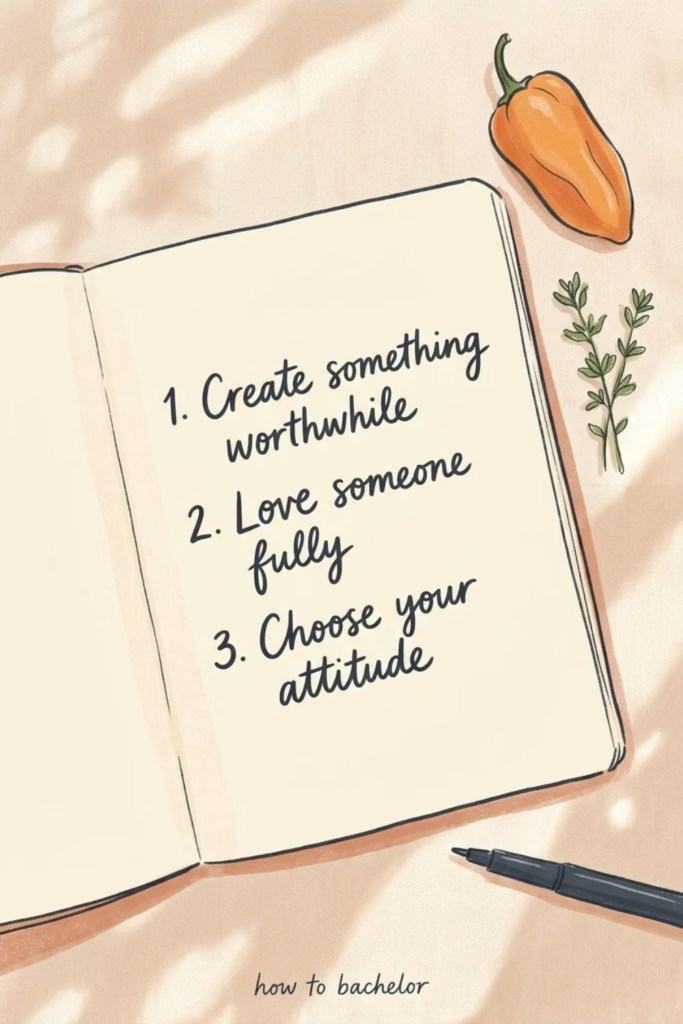
1. Creating or doing something worthwhile.
This is the route most people find easiest to understand. You build something, write something, teach something, fix something. You contribute. The key word is “worthwhile,” not “impressive.” Frankl’s framework doesn’t care whether your creative output goes viral. It cares whether you brought something into the world that didn’t exist before, or served a purpose that mattered to somebody.
A guy coaching his kid’s soccer team on Saturday mornings qualifies. A nurse doing the same unglamorous shift for the fifteenth time this month qualifies. The novelist nobody’s heard of yet qualifies. This route is wider than it looks.
2. Experiencing love or another person.
This one is softer and harder at the same time. Frankl’s point is that the experience of genuine connection, love, care, real attention, is itself a source of meaning. Not a means to an end. The thing itself.
A 2021 scholarly analysis of Frankl’s framework identified this as one of the core meaning-making strategies, alongside creative activity, serving others, and pursuing goals, per PMC. Which, when you look at that list, is quietly telling you that meaning is available in ordinary daily life, not only in extraordinary moments.
If you’re a stressed parent trying to find purpose in the grind of it all, this is probably your most available route right now. The family meal where you’re actually present instead of mentally composing tomorrow’s to-do list. The phone call you make because someone’s been heavy on your mind. Those count.
Route 3: The One That Separates Frankl From Everyone Else
3. Choosing your attitude toward unavoidable suffering.
This is the one that separates Frankl from almost every other voice in this space. Not that suffering is good, or that hardship makes you stronger (a useful myth, not a reliable one), but that when suffering cannot be immediately removed, you still get to choose how you meet it.
Frankl was explicit on this: suffering is not necessary for meaning, and seeking it out would be absurd, per this breakdown. The question isn’t “how do I find the silver lining?” The question is “given that this is happening right now, what is the most responsible, most human stance I can take toward it?” That’s a very different ask.
Why This Matters More Than Ever Right Now
There’s a specific modern trap that Frankl’s framework cuts straight through. We live in an era where your identity is increasingly something you perform and broadcast. Your purpose has to be scalable. Your growth has to be visible. Your “journey” needs content.
Which means a lot of people are out here confusing the image of a meaningful life with the actual experience of one. (These are not the same thing. I know this because I have a Facebook page for this site with 0 followers). That’s the character-over-image version of self-improvement: who you are inside the ordinary day, not who you look like from outside it.
The hustle-bro version of purpose is built almost entirely on Route 1, creation, achievement, output, while quietly ignoring Routes 2 and 3 entirely. It treats love and chosen attitude as soft, optional, secondary. But Frankl’s clinical work, and a fair amount of subsequent psychology, suggests those aren’t the weaker routes. They’re often where the most durable meaning lives.
A longitudinal study of 293 university students found that meaning confusion, not hardship itself, mediated the relationship between adverse experiences and depression and anxiety, per PubMed. Read that again: it wasn’t the difficult thing that hurt most. It was not knowing why any of this matters. The lost compass, not the storm.

That’s the diagnostic question worth sitting with. Not “is my life hard right now?” but “do I know what today’s effort is actually for?”
How to Apply Frankl’s Philosophy to Your Life (Without Making It a Project)
This is where a lot of Frankl explainers go abstract and leave you holding the philosophy like a nice rock you don’t know what to do with. Let’s get specific.

Start with the smallest honest route available to you today.
If you’re exhausted, if the year has been genuinely rough, don’t start with “what is my purpose?” That question is too big and too loaded right now. Start with Route 2: is there one person in your life you can be fully present with tonight? Not productively. Just actually there. That’s enough.
Reframe the unglamorous stuff as chosen service.
Frankl’s documented strategies included perceiving apparently meaningless tasks through a meaningful lens, per PMC. The contemporary version: the repetitive work, the thankless household maintenance, the caregiving shift that nobody photographs, when you consciously frame these as chosen acts of service to specific people you care about, the psychological weight of them changes. Not into joy, necessarily. Into something you can carry.
This is different from toxic positivity (“find the blessing in everything!”). It’s a deliberate cognitive move: I could resent this, or I can notice that I’m choosing it because of who it’s for.
Use Route 3 as a pressure valve, not a first resort.
The attitude-toward-suffering route isn’t license to stay in bad situations. If a job is genuinely harming you, leave it. If a relationship is genuinely destructive, address it. Route 3 applies to unavoidable suffering, grief, illness, circumstances you can’t immediately change. The practical question: given that I can’t fix this tonight, what is the most grounded, honest way I can meet it?
There’s a version of this in the way Mr. Miyagi approaches everything, actually. Quiet commitment to the thing in front of you, trusting that it means something even when it looks like waxing a car. (We have a whole piece on that brand of quiet self-improvement if that angle lands for you.)
Stop auditing whether your meaning is impressive enough.
This might be the hardest one. Frankl’s framework doesn’t care whether your source of meaning would make a good Instagram caption. Choosing a slower career track to be present for your kids isn’t a failure of ambition, it’s a meaning decision. Deciding that “enough” looks like a small business that pays the bills and lets you sleep well isn’t a consolation prize. It might be the most responsible thing you could choose.
John Wooden built his Pyramid of Success on character first, not results. The overlap with Frankl is striking: both root genuine success in who you are when it costs you something, not what you’re performing for the room.
What “Enough” Has to Do With Any of This
There’s a through-line between Frankl’s framework and the idea of defining your own “enough” before you start chasing things. Frankl would say: if you don’t know what your life is for, you’ll optimize endlessly for the wrong things and wonder why the finish line keeps moving.
Plant the finish line first. Not someone else’s finish line. Yours.
Meaning isn’t found at the destination. It’s the thing that makes the walking feel like it’s going somewhere. And according to Frankl, and a lot of subsequent clinical work, it doesn’t require extraordinary circumstances. It requires attention to what’s actually in front of you: the work worth doing, the people worth loving, and the stance worth taking when life doesn’t cooperate.
That’s the whole philosophy, honestly. The rest is footnotes.
Frequently Asked Questions
What are Viktor Frankl’s three routes to meaning?
Frankl identified three ways to find meaning: creating or doing something worthwhile, experiencing love or genuine connection with another person, and choosing your attitude toward suffering you cannot immediately remove, per this overview. These routes aren’t a hierarchy, any one of them is available to you right now, today, regardless of your circumstances.
Did Frankl say suffering is necessary for meaning?
No. Frankl was explicit that suffering is not necessary for meaning, and that seeking it out would be pointless, per this overview. His argument was narrower and more useful: when suffering is unavoidable and can’t be immediately removed, meaning remains possible within it. That’s a very different claim from “hardship makes you stronger.”
What does research say about meaning and mental health?
A three-wave longitudinal study of 293 university students found that meaning confusion, not hardship itself, mediated relationships with depression and anxiety, per PubMed. In plain terms: it wasn’t the difficulty that did the most damage. It was not knowing what the difficulty was for.
Does meaning have to come from something impressive or ambitious?
According to Frankl’s framework, no. A 2021 scholarly analysis identified meaning-making strategies that include serving others, pursuing goals, creative activity, and reframing apparently meaningless tasks, per PMC. Ordinary contribution, a recurring family ritual, a thankless caregiving task, consistent unglamorous work, qualifies fully.
How do I start applying Frankl’s philosophy today?
Applying Viktor Frankl’s philosophy to your life doesn’t have to start with a big question. Don’t start with “what is my purpose?”, that question is too big when you’re already tired. Start smaller: identify which of the three routes is most accessible right now, and take one concrete step in that direction. Be fully present with one person tonight, reframe one repetitive task as chosen service, or simply name the stance you want to take toward one thing you can’t control yet. That’s not a scaled-down version of the philosophy. That is the philosophy.
The one thing worth doing tonight: pick the smallest route available. Not the most impressive one. The most honest one. Write it down if that helps, one sentence: “Tonight this matters because…” Then go do it.
The meaning isn’t waiting for you to deserve it. It’s already sitting there in whatever’s right in front of you.
Get The Enough List — free.
Ten minutes, five areas. A short guide for figuring out what enough looks like in money, health, work, people, and time — before you go sprinting at someone else's finish line. Yours when you subscribe.

Thoughts?