

Bill Watterson drew the last Calvin and Hobbes strip on December 31, 1995. The strip was at the height of its popularity. He walked away anyway. That’s the whole lesson, really, but let’s unpack why it matters for the rest of us who aren’t comic-strip legends with a tiger for a best friend. That’s the core of it, and the lessons from Bill Watterson that actually stick aren’t about cartooning.
One of the clearest lessons from Bill Watterson is this: knowing when to stop is a skill, and most people never develop it. We’re wired to keep going. More output, more reach, more monetization. Watterson looked at all of that and said no, repeatedly, and on purpose.
Key Takeaways
- Bill Watterson syndicated Calvin and Hobbes from 1985 to 1995 and ended it voluntarily at peak popularity, not out of burnout or collapse.
- Watterson resisted pressure to license or commercialize Calvin and Hobbes, choosing the integrity of the work over easy money.
- In his Kenyon College commencement speech, Watterson argued that the fun of cartooning was in the work, not the money, a case for intrinsic motivation over endless expansion.
- Knowing when to stop is its own skill: leaving before diminishing returns set in preserves the meaning that made the thing worth doing.
- Watterson’s commencement line, ‘To invent your own life’s meaning is not easy, but it’s still allowed’, frames walking away as a self-defined act, not a retreat.
Saying No Was the Work
Watterson resisted intense pressure to license and commercialize Calvin and Hobbes, stuffed animals, Saturday morning cartoons, the full merchandise circus. He turned it down. Not because he was naive about money, but because he understood something most of us take years to figure out: more of a good thing, packaged cheaply enough, becomes a different thing.
That’s not stubbornness. That’s integrity with a plan behind it.
In his Kenyon College commencement speech, Watterson was direct about his motivation: the fun of cartooning wasn’t in the money, it was in the work. He also said, “We define ourselves by our actions.” Not our revenue. Not our follower count. Our actions. (Which is either deeply freeing or deeply inconvenient, depending on your recent choices.)
What Bill Watterson’s Lessons Say About Repetition and Magic
There’s a reason Calvin and Hobbes still hits differently decades later. It ended before it got tired.

Watterson’s argument was essentially: once a thing stops feeling true, forcing more of it doesn’t preserve the magic, it just produces more content. And the world, as you may have noticed, is not short on content.
This is the counterintuitive part. We’re taught that quitting is failure. Push through. Grind it out. But Watterson’s 10-year run wasn’t a retreat, it was a finished sentence. There’s a real difference between quitting because something got hard and stepping back because the work is genuinely complete. One is avoidance. The other is judgment.
Most of us never stop long enough to ask which one we’re actually doing.
How to Know When You’ve Hit Enough
Here’s the framework Watterson modeled, even if he never wrote it out this neatly:
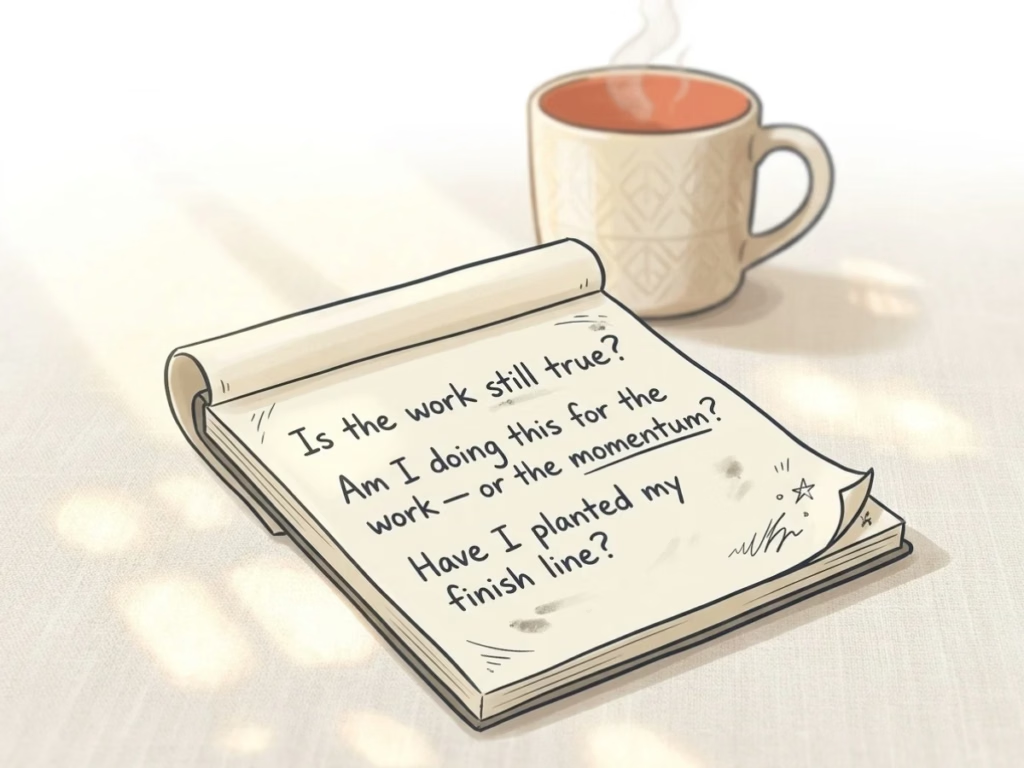
- Is the work still true? Not popular, not profitable, true. Does it still reflect what you actually care about?
- Are you continuing for the work, or for the momentum? There’s nothing wrong with momentum, but it’s a terrible reason to keep doing something that’s run its course. This is voluntary simplicity in practice. Not deprivation, just a clear-eyed decision to stop overcommitting to things that have run their course.
- Have you planted your finish line? Watterson didn’t leave Calvin and Hobbes on a whim. He knew what the strip was for, and he knew when it was done. Plant the finish line before you sprint at it.
Watterson’s commencement speech put it this way: “To invent your own life’s meaning is not easy, but it’s still allowed, and I think you’ll be happier for the trouble.” That’s the quiet radicalism in his whole career. He defined success himself, hit it, and stopped. The rest of us are still arguing about what the scoreboard even means.
If you’ve ever felt the itch to keep going past the point where the thing still feels good, and ignored it because stopping seemed like failure. Watterson’s exit is worth sitting with. It’s also worth reading alongside what Mr. Rogers taught us about quiet strength, because both men made “no” look like a complete sentence.
Frequently Asked Questions
Why did Bill Watterson end Calvin and Hobbes?
Watterson ended the strip voluntarily in 1995 after a 10-year run, citing a desire to stop before the work felt forced rather than genuine. He wasn’t burned out in the collapse sense, he felt the strip had said what it needed to say. Walking away at the peak was the point, not a symptom of anything going wrong.
What did Bill Watterson say about money and success?
In his Kenyon College commencement speech, Watterson said the fun of cartooning wasn’t in the money, it was in the work. He consistently framed success around intrinsic motivation rather than revenue, which is either very wise or very annoying to hear, depending on your bank account at the time.
What does it mean to “know when to walk away” from something you love?
It means being honest about whether you’re continuing because the work is still alive or because stopping feels like giving up. These are very different things, and most people don’t stop to ask. The goal is to finish on your own terms, not because things got hard, but because the thing is genuinely done.
How do you avoid staying in something past its expiration date?
Ask what “enough” looks like before you start, and revisit it regularly. When the answer has arrived and you’re still going, that’s your signal. Watterson resisted years of commercial pressure to expand Calvin and Hobbes into licensing deals, having a clear sense of what the work was for made it easier to say no to everything it wasn’t.
Today’s move: Pick one thing in your life you’ve been continuing mostly out of momentum. Give yourself five minutes and genuinely ask: is this still true? You don’t have to quit it today. Just answer the question honestly.
Get The Enough List — free.
Ten minutes, five areas. A short guide for figuring out what enough looks like in money, health, work, people, and time — before you go sprinting at someone else's finish line. Yours when you subscribe.

Thoughts?