

Making friends as an adult man is genuinely hard, and the reason has almost nothing to do with your personality. According to friendshiprecession.com, 17% of Americans had no close friends in 2024, up from 3% in 1990. Men are carrying more than their share of that weight: 15% of U.S. men reported having no close friends in 2021, versus 3% in 1990. That’s not a personality epidemic. That’s a structure problem, and structure problems have structure solutions.
The good news is that “not being weird about it” turns out to be mostly about doing less, not more. You don’t need a script, a personality transplant, or a podcast recommendation to bond over. You need repetition, a low-pressure ask, and the patience to follow through more than once. That’s it. Let’s talk about how to actually do it.
Key Takeaways
- 17% of Americans had no close friends in 2024, up from 3% in 1990, and men are disproportionately affected, per friendshiprecession.com.
- 15% of U.S. men reported having no close friends in 2021, a five-fold increase from 3% in 1990, per The Guardian.
- Researcher Jeffrey Hall’s work suggests it takes roughly 50 hours of time together to become casual friends and 200+ hours to become close friends, which reframes friendship as a scheduling problem, not a personality problem.
- AARP research found Gen X men feel lonelier than boomer men, and adults cite ‘no time’ as the primary reason their friendships lack depth.
- The core conditions for adult friendship are repeated contact, shared activity, and gradual vulnerability, none of which require you to be naturally outgoing.
Why Making Friends as an Adult Man Gets So Hard (It’s Not You)
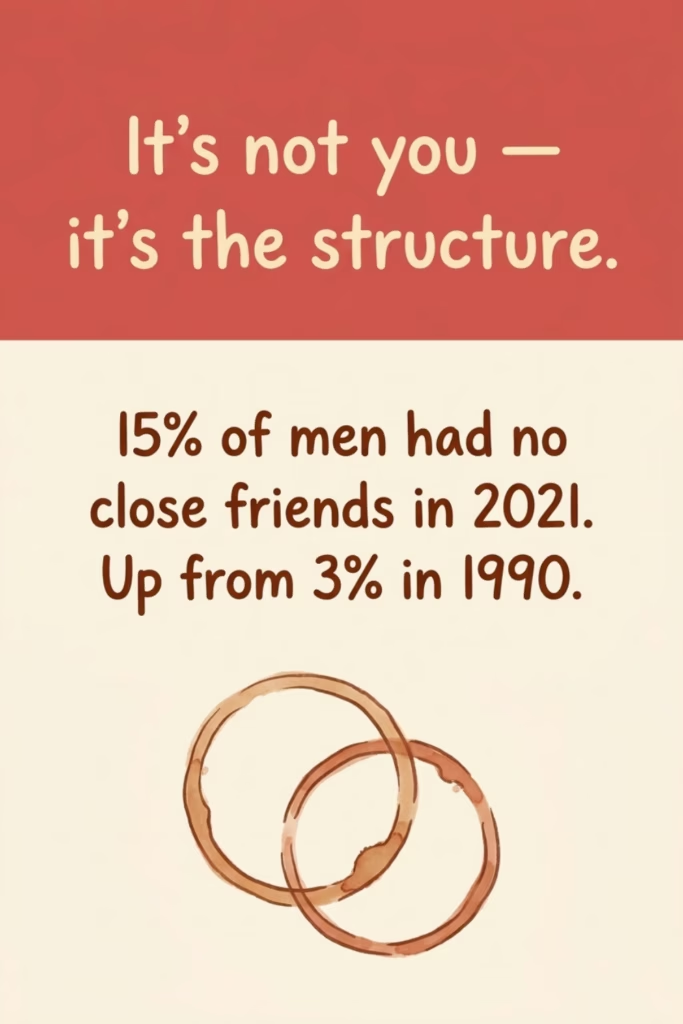
There’s a particular flavor of loneliness that hits in your 30s and 40s that nobody really prepares you for. School and early work life handed you proximity: same building, same schedule, same low-stakes reason to hang around. Then life got louder. You moved, changed jobs, had kids, got busy in a thousand invisible ways, and the social scaffolding that used to do the heavy lifting just… quietly collapsed.
AARP’s research on Gen X men and friendship found that in-person communication has declined significantly over the past six years, and that adults cite “no time” as the main reason their friendships lack depth. Not shyness. Not conflict. Just time, or rather, the feeling that there isn’t any.
The same AARP data found that Gen X men feel lonelier than boomer men. Which is interesting, because Gen X is the generation that gave us “whatever” as a cultural posture. Turns out the “too cool to care” thing has some long-term side effects. (Who knew.)
The other thing that changes: the social permission structure shifts. You could show up to a party in college knowing two people and leave with six phone numbers and nobody thought anything of it. Do that at 38 and it feels like you’re auditioning for something. So men stop trying, or they try once and feel awkward and file it under “that’s just not me anymore,” and the gap widens.
None of this means you’re broken. It means the context changed and you haven’t found a new playbook yet. Here’s one.
The Real Bottleneck Isn’t Meeting People
Here’s the thing that most “how to make friends as an adult man” advice gets wrong: it focuses almost entirely on how to meet people, which is rarely the actual problem. Most men have people in their orbit. Coworkers. Gym regulars. Guys from the youth soccer sidelines. Neighbors they wave to.

The bottleneck is what happens in the 72 hours after a decent conversation. Which is usually: nothing.
Researcher Jeffrey Hall’s friendship research suggests it takes roughly 50 hours of time together to move from stranger to casual friend, and over 200 hours to build a close friendship. Two hundred hours. Let that land for a second. That’s not a coffee meeting. That’s months of consistent, low-pressure contact. Which means the question isn’t “how do I make a great first impression”, it’s “how do I keep showing up without it getting weird?”
The answer is simpler than you’d think: you ask, you follow up, and you keep the bar low enough that it’s easy to say yes.
Start With Repeated Context, Not Effort
The most durable friendships in adult life almost always come from a shared recurring activity. Not a one-off event. Not “we should grab drinks sometime.” A standing thing, a volleyball league, a running club, a poker night, a book group you’re slightly too embarrassed to tell anyone about. (Good for you.)
Why recurring? Because it solves the follow-up problem automatically. You don’t have to manufacture a reason to see the person again, the reason already exists. It’s on the calendar. You just show up.
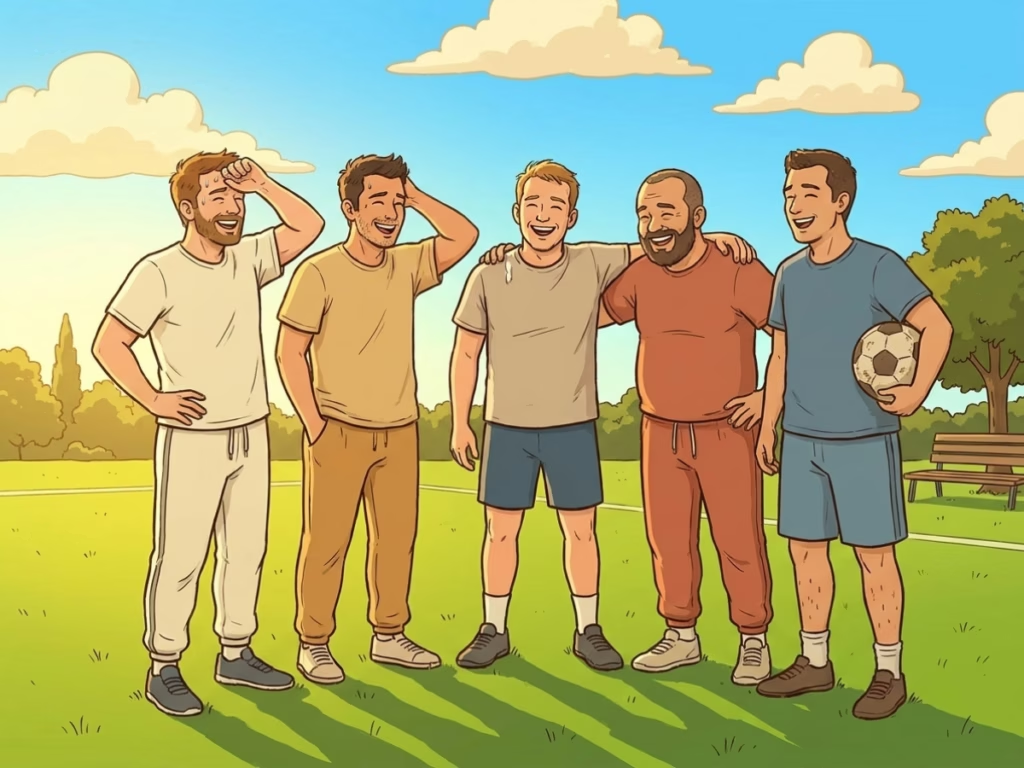
This is the core insight that most advice buries under motivation talk: adult friendship is less about chemistry and more about logistics. Same people, same place, same schedule, repeated over time. The relationship builds in the margins, before and after the activity, in the parking lot, over the group chat about who’s bringing the snacks.
If you’re starting from zero, pick something you’d actually enjoy doing alone. That way, even if the friend part takes a while (and it will), you’re not grinding through an activity you hate waiting for a payoff. Hike if you like hiking. Play chess online and find a local club. Coach a kids’ team. Take a cooking class.
How to Actually Make the Ask (Without Overthinking It)
Here’s where the “without being weird” part lives. Most men overthink the ask. They wait for the perfect moment, or for the other person to make the move first, or until they have something better to suggest than “want to grab coffee.” The ask dies in the drafts.
The fix is to lower the ask so far that it’s almost impossible to decline. Not dinner, that’s a lot. Not “we should hang out sometime”, that’s nothing. Something in between:
- “There’s a trail I’ve been meaning to try, want to come Saturday morning?”
- “I’m watching the game at [place] Sunday if you want to show up.”
- “I’m doing a fantasy football thing, you in?”
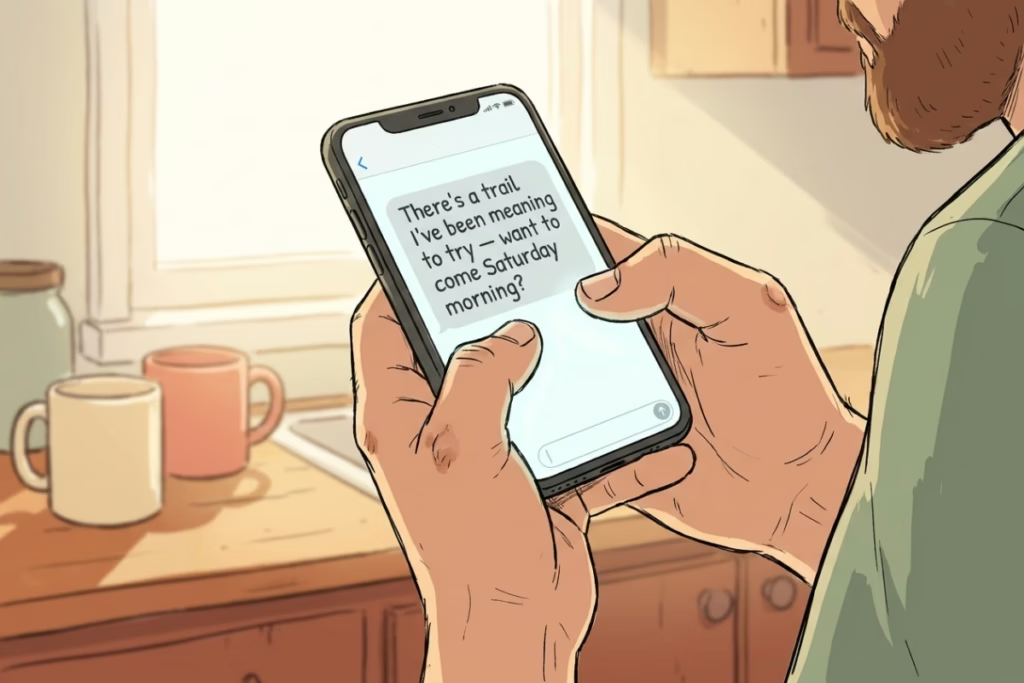
Notice what those have in common: specific time, specific activity, low pressure, easy out if they’re busy. You’re not asking them to be your friend. You’re asking them to do one small thing that you’re already planning to do.
If they say yes, great. If they say no, say “no worries, another time” and mean it. Then actually try another time, maybe once or twice more. If it still doesn’t happen, you’ve learned something useful and spent almost no social capital finding out.
If they say yes and it goes well, follow up within a week. Not with a deep conversation about whether you’re becoming friends, just another low-lift invite, or even a relevant link or meme that connects to something you talked about. That small, frictionless touchpoint does more work than you’d expect. It says “I was still thinking about our conversation” without saying anything that strange out loud.
Depth Comes From Showing Up, Not From Opening Up (At First)
There’s a version of friendship advice that tells you to be vulnerable early, share your struggles, go deep. And eventually, yes, that’s where real friendship lives. But trying to skip straight to that with someone you’ve known for three weeks is how you become “the guy who told me about his divorce on our second coffee.”
The actual path to depth is simpler and less dramatic: just keep showing up. Relationship writers who point to Hall’s research consistently highlight repeated contact, shared activity, and gradual vulnerability as the conditions for closeness. Gradual is doing a lot of work in that sentence.
Depth builds naturally when the relationship has enough surface area. In-jokes accumulate. You learn each other’s opinions on dumb things. You find out his dad is sick, or he finds out you’ve been stressed about work, not because anyone sat down for a Feelings Conversation, but because it came up organically in the middle of doing something else. That’s how it usually goes.
The only thing you’re actively managing at this stage is consistency. Show up when you said you would. Follow through on small things. Be someone whose word means something. That’s character work, and it’s quiet, nobody’s posting your follow-through rate on Instagram, but the person on the other end of it notices.
A Note on Time, Because You Probably Don’t Feel Like You Have Any
The AARP data is pretty honest about this: adults, especially men in midlife, cite time as the number one barrier to deep friendships. And if you’re a busy dad or running a household or working long hours, that pressure is real.
But there’s a useful reframe here. You don’t need big blocks of time. You need consistent small ones. A standing Tuesday morning run with one guy is more friendship-building than a quarterly “big night out” that gets rescheduled four times before it happens. Small and reliable beats big and theoretical.
The other thing worth saying: friendship competes with everything else on your plate. Protect a little space for it the same way you’d protect time for the gym or a hobby you actually care about. That sometimes means saying no to other things, which is its own skill, and worth building separately.
On Moving to a New City (or Starting from Scratch)
If you’ve recently relocated, or if the last few years scattered your existing friendships, the problem feels more acute. Everyone already has their people, the logic goes, and you’re the outsider.
This is mostly a story you’re telling yourself, and it’s worth interrogating. Adults lose friends constantly, to moves, to life changes, to just drifting. Most people in any given social setting are actively looking for more connection than they currently have. They’re just not saying so out loud, because that also feels weird.

In a new city, the recurring-activity approach is basically the whole playbook. Apps like Meetup, local subreddits, community sports leagues, CrossFit boxes, local run clubs, these exist precisely because the demand for social structure is real. You’re not desperate for using them. You’re practical. (I signed up for a recreational soccer league in my mid twenties knowing I hadn’t played since high school. My knees never fully forgave me.)
The other move: lean on loose ties. That former coworker who moved to the same city two years ago. The guy you went to college with who you’ve texted sporadically. A warm intro is infinitely easier than a cold one, and most people are genuinely glad to hear from someone they already know. Worst case, you grab one coffee and it goes nowhere. Best case, you have a friend who can invite you into a circle that already exists.
Frequently Asked Questions
How long does it actually take to make a close friend as an adult?
Researcher Jeffrey Hall’s friendship research is commonly summarized as roughly 50 hours of shared time to become casual friends, and 200 or more hours to become genuinely close. That sounds like a lot, but it adds up faster than you’d think with a regular shared activity, a weekly run, a standing game night, a consistent workout partner. The timeline is less about intensity and more about showing up repeatedly over months.
Why do men specifically struggle to make friends as adults?
Learning how to make friends as an adult man is harder than it looks, partly because male friendship has traditionally been built around shared activity rather than direct emotional conversation.. 15% of U.S. men reported having no close friends in 2021, up from just 3% in 1990. Part of the issue is that male friendship has traditionally been built around shared activity rather than direct emotional conversation, which means when the activity structure disappears (school, early work life, team sports), the friendship often goes with it. Men also tend to communicate less frequently with close friends than women do, which means gaps widen faster without much notice.
Is it weird to try to make new friends in your 30s or 40s?
Not remotely, though it can feel that way. AARP research found that Gen X men feel lonelier than boomer men, which suggests this is a widespread experience, not a personal failure. The weirdness mostly lives in your head, most men in midlife are quietly looking for more connection than they have. You asking someone to grab coffee or join a run isn’t desperate; it’s just doing the thing most people are thinking about but not saying.
What’s the best way to make friends as an introverted man?
Recurring, structured activities are your natural habitat. You don’t have to be “on” for hours at a stretch or work a room. A weekly chess club, a running group, a regular poker game, these give you a context that does the social lifting, and you show up inside it. The depth builds gradually in the margins of the activity, not in one big social performance. Lower-volume, higher-consistency contact is how introverts build durable friendships, and that’s actually a strength in disguise.
How do I stop the friendship from fading after a good first conversation?
Follow up within a week with something low-effort and specific. A link to something relevant to what you discussed, a follow-up invite to a specific time and place, or even a genuinely funny text that connects to something from your last conversation. The content matters less than the timing. One touchpoint within a week signals that you’re interested and worth staying in touch with. Without it, even a great first conversation evaporates into “we should definitely hang out sometime”, which is the place friendships go to die.
One Thing to Do Today
Pick one person you’ve had a decent conversation with in the last month and haven’t followed up with. Not your best candidate. Not the most strategic connection. Just someone you actually liked talking to. Send them one message today: invite them to one specific, low-stakes thing you’re already doing this week or next. Keep it simple. Keep the bar low. See what happens.
That’s not a grand gesture. That’s not “putting yourself out there” in some exhausting, performative way. It’s just the first of however many small moves it takes to build something real. The 200 hours doesn’t start until you start.
You’re allowed to be a work in progress on this one too.
Get The Enough List — free.
Ten minutes, five areas. A short guide for figuring out what enough looks like in money, health, work, people, and time — before you go sprinting at someone else's finish line. Yours when you subscribe.

Thoughts?