

Your to-do list has probably become a hostage situation. Real deadlines and “eh, maybe someday” ideas are crammed together, staring at you, and the longer the list grows the less any of it gets done. A might-do list fixes exactly that. That’s the core of the might-do list vs to-do list question: one holds your real commitments, the other holds everything else.
The concept is simple: a might-do list is a separate home for tasks you’d genuinely like to do, but haven’t committed to yet, per Make Time. Nothing lives there permanently, items move to your calendar when you decide they’re actually happening. Until then, they’re out of your way.
Key Takeaways
- A might-do list holds low-priority tasks until you choose to schedule them, preventing your active to-do list from becoming a guilt trip in bullet form.
- Mixing ideas and obligations on the same list is a documented planning problem, a might-do list keeps the two categories honest and separate.
- Writing down non-priority tasks helps your brain stop revisiting them throughout the day, functioning as a low-tech mental offload.
- On low-capacity days, capping your active list at three small tasks and parking the rest on the might-do list is a practical way to protect your attention.
- The might-do list is the closest everyday analogue to David Allen’s GTD ‘Someday/Maybe’ list, a holding pen, not a graveyard.
Might-Do List vs To-Do List: Why Your Current One Is Lying to You
The problem with a standard to-do list is that it treats “repot the cactus” and “submit the quarterly report” as moral equals. They are not. One is a commitment; one is a wish. Mixing them on the same list inflates the whole thing into something that feels urgent but mostly isn’t, and that feeling is what turns a productivity tool into a low-grade anxiety machine.
A might-do list separates ideas from obligations. Only things you truly intend to do belong on your active list, everything else parks in the might-do column until you’re ready to make a real call. Think of it less like a waiting room and more like a menu. You choose from it when you have appetite and capacity. No choosing means no guilt.
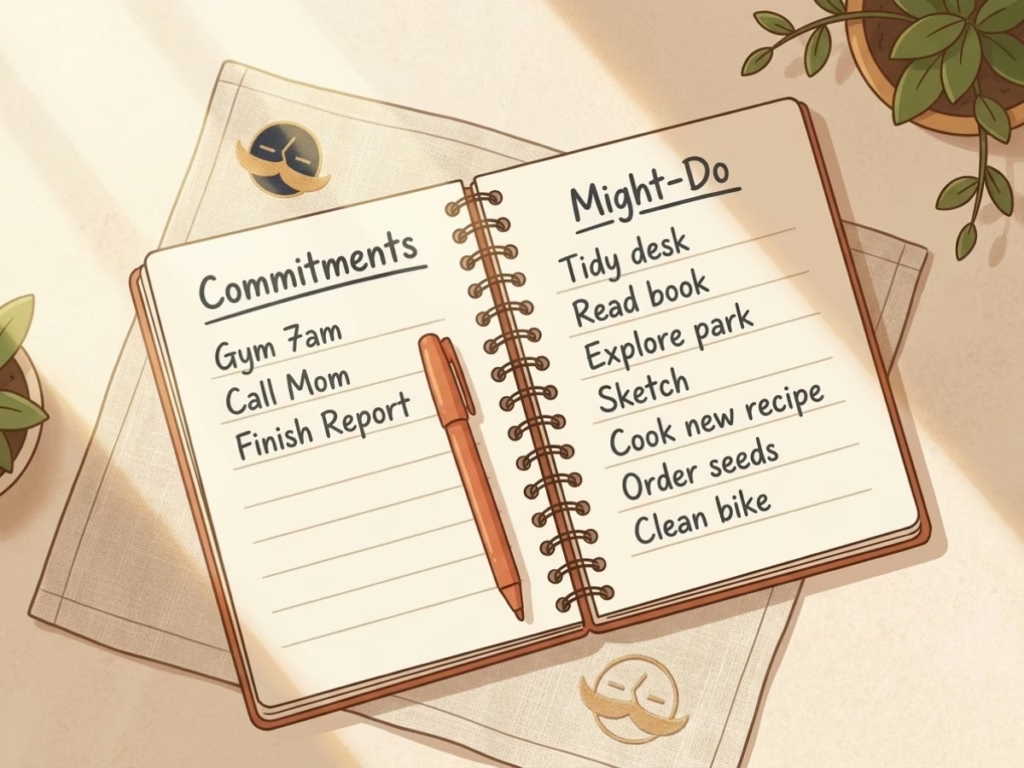
It’s basically a civilian version of David Allen’s GTD “Someday/Maybe” list, which has been around long enough that your dad’s productivity book probably mentioned it, per Make Time. The insight holds up.
How to Set One Up in Five Minutes
You don’t need an app, a system, or a $40 planner with a ribbon bookmark.
- Brain dump first. Write down everything rattling around in your head, work stuff, home stuff, that half-formed idea about learning to make pasta from scratch. All of it, no filter.
- Sort ruthlessly into two columns. Left column: things with a real deadline or genuine commitment. Right column: everything else. The right column is your might-do list.
- Cap your active list. On a normal day, three to five items is enough. On a rough day, pick up to three tasks and make them as small as possible. The might-do list absorbs the rest without shame.
- Review the might-do list weekly, not daily. Once a week, look at it and ask: does anything here belong on the calendar now? If yes, schedule it. If no, leave it. That’s the whole review.

(I have a might-do list item about organizing my bookmarks folder that has been there for eleven months. It brings me no distress whatsoever. Growth.)
What This Actually Does to Your Brain
Writing down a non-urgent task quiets the part of your brain that keeps reopening it.

It’s the mental equivalent of putting something in a drawer instead of leaving it on the kitchen counter where you bump into it seventeen times a day. The task isn’t gone. Your brain just stops treating it like a fire drill.
If you’ve ever noticed that a tight, honest to-do list feels lighter than a long aspirational one, this is why. Fewer items means less decision overhead, and less decision overhead means more actual doing. The might-do list isn’t laziness, it’s honesty. Related: the anti-to-do list takes the same logic and runs further with it.
Frequently Asked Questions
What is the difference between a might-do list and a to-do list?
A to-do list holds committed tasks with real deadlines or intentions. A might-do list holds possibilities, things you’d like to do someday but haven’t scheduled or committed to yet, per Make Time. Keeping them separate stops wishful thinking from inflating your active list into something unmanageable.
Is a might-do list the same as a someday/maybe list?
Essentially, yes. David Allen’s GTD “Someday/Maybe” list and the might-do list work the same way: a holding pen for low-priority tasks that stays out of your daily workflow until you deliberately move something to the calendar, per Make Time. Different name, same pressure valve.
How is a might-do list different from a could-do list?
They’re close cousins. A could-do list is framed as a brain dump of everything you could theoretically tackle, used as a stress-free alternative to a standard list. A might-do list leans slightly more intentional, items there are things you actually want to do, just not yet. Either way, the core move is the same: get it out of your head and off your active list without losing it.
How often should I look at my might-do list?
Once a week is enough. The point is NOT to review it daily, that defeats the purpose by putting the anxiety back. A weekly check-in lets you ask “is anything here ready to become a real commitment?” and then close the notebook. Most weeks, the answer is “not much, and that’s fine.”
What if I never do anything on my might-do list?
Then those things weren’t really priorities, and now you know. That’s useful information, not a failure. Delete them, feel briefly smug, and move on.
Today’s action: take five minutes, write down everything on your mental pile, and split it into two columns. Real commitments on the left, everything else on the right. That right-hand column is your might-do list. You’ve just bought back a little peace of mind, and you didn’t have to buy a planner to do it.
If you want a complementary angle on keeping your commitments honest, the good-enough goal sanity check is worth a read.
Get The Enough List — free.
Ten minutes, five areas. A short guide for figuring out what enough looks like in money, health, work, people, and time — before you go sprinting at someone else's finish line. Yours when you subscribe.

Thoughts?