

The problem almost never is that you don’t know what to do. It’s that you can’t make yourself start.
Here’s the fix, and it’s genuinely small: you commit to one specific action tied to one specific moment. Not “I’ll work on it later.” More like: “When I pour my morning coffee, I will open the document and write one sentence.” That’s it. That’s the one-step rule for procrastination, and the research behind it is surprisingly not depressing.
Key Takeaways
- Forming a specific if-then implementation intention made participants nearly 8x more likely to keep their appointments than those relying on vague intentions, per a study of 152 university students.
- A 2018 meta-analysis of 94 studies found implementation intentions produce a medium-to-large effect on goal follow-through (d = 0.65) compared to no intervention.
- Daily if-then planning reduced bedtime procrastination by around 19 minutes on average compared to planning just once a week, per a 2025 registered report.
- The one-step rule works best when tied to a cue, not a mood, ‘when I sit down with coffee’ beats ‘when I feel ready.’
- Low procrastinators outperformed high procrastinators on follow-through (49.4% vs 30.1% attendance), but if-then plans narrowed that gap significantly.
Why “Just Do It” Is Terrible Advice
Motivation is not a reliable alarm clock. It shows up when it wants to and ghosts you the rest of the time (we’ve all been there). What actually moves the needle is what psychologists call an implementation intention, a simple “when X, then Y” plan that removes the decision from the equation entirely.
Across 94 studies, implementation intentions produced a meaningful, consistent bump in goal follow-through, with a meta-analytic effect size of d = 0.65 compared to no intervention, per this 2018 review. That’s not a motivational poster stat. That’s a real, reproducible finding. In one study of 152 university students, people who formed these specific if-then plans were nearly 8 times more likely to actually show up to their appointments than those who just… intended to (source). Eight times. For writing one sentence on a sticky note.
How to Use the One-Step Rule for Procrastination
The format is almost embarrassingly simple:
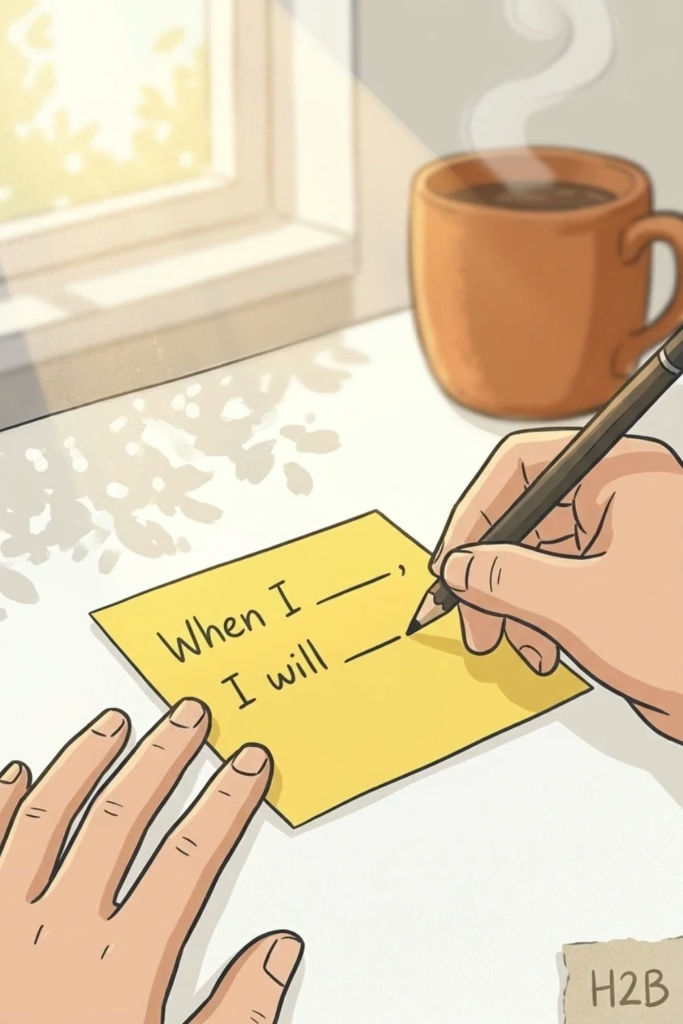
“When [situation], I will [first tiny action].”
Not “I’ll exercise more.” Try: “When I put on my shoes after work, I will walk to the end of the street.” Not “I’ll work on my side project.” Try: “When I close my laptop at lunch, I will sketch one idea in my notebook.”
Notice what those plans have in common: they’re tied to a cue, not a mood. “When I feel motivated” is not a cue. It’s a wish. Cues are specific, observable, and happen whether you’re fired up or running on four hours of sleep and leftover pizza.
The cue is doing the heavy lifting here. You’re not relying on willpower, you’re basically outsourcing the decision to your environment. Future you will thank present you, even if present you is mildly annoyed about it.
A 2025 registered report found that doing this kind of if-then planning daily (rather than once a week and hoping for the best) reduced bedtime procrastination by around 19 minutes on average (per Taylor & Francis online). Nineteen minutes. Every night. From writing a single sentence on a notepad before bed.
If this sounds weirdly similar to the two-minute rule or the do it badly method, that’s because they’re all pointing at the same truth: starting is the whole job. Everything else is just maintenance.
Frequently Asked Questions
What exactly is the one-step rule for procrastination?
It’s the practice of committing to one specific micro-action tied to a specific cue rather than relying on motivation or vague intentions. The formal term is an implementation intention, structured as “When X, I will do Y.” A 2018 review of 94 studies found this approach has a consistent, medium-to-large effect on follow-through (source). Think of it as setting a trap for your future, less-motivated self, a friendly one.
Does the one-step rule actually work, or is it just another productivity hack?
The evidence is more solid than most productivity advice. Participants who used if-then plans were nearly 8 times more likely to follow through on their intentions than those who didn’t, in a study of 152 university students (source). It’s not magic, and it doesn’t fix every type of procrastination, but it works better than most things that get a book deal.
This is also why therapists sometimes use behavioral activation for procrastination, pushing you to act before you feel ready, because the feeling often follows the action, not the other way around.
How small does the “one step” need to be?
Smaller than you think. The goal is to guarantee you can’t say no. “Write one sentence” works. “Do one push-up” works. “Open the app” works. The research focus is on cue-linked specificity, not size. Once you’re actually in motion, finishing is usually the easier part.
What if I do the one step and still don’t continue?
That’s fine, actually. The one-step rule isn’t trying to trick you into a four-hour session, it’s trying to break the freeze. Sometimes you do the one step, stop, and that’s still a win over doing nothing. More often you’ll keep going, because starting was the only real obstacle. Momentum is quieter than motivation, but it’s a lot more reliable.
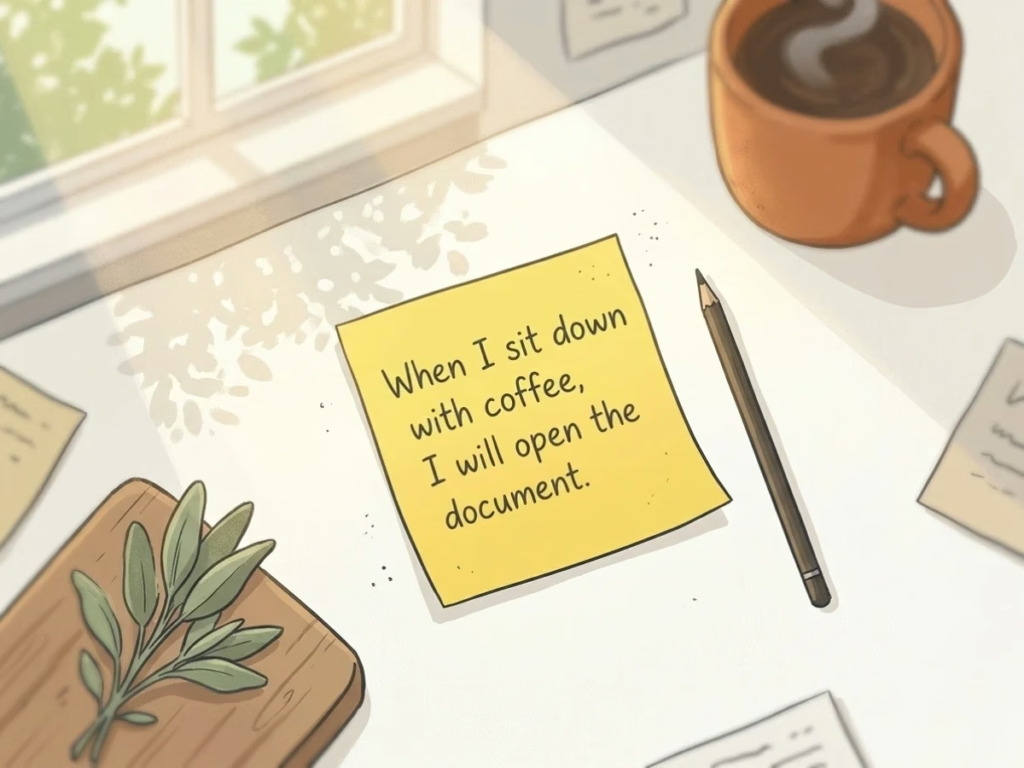
Your one action today: pick the task you’ve been avoiding longest and write this sentence somewhere you’ll see it tomorrow morning: “When I [your cue], I will [your first tiny action].” That’s it. Don’t plan the whole thing. Don’t map out the finish line. Just plant the one step and let tomorrow-you trip over it.
If you want more on why starting small beats planning big, the do it badly method is worth five minutes of your time.
Get The Enough List — free.
Ten minutes, five areas. A short guide for figuring out what enough looks like in money, health, work, people, and time — before you go sprinting at someone else's finish line. Yours when you subscribe.

Thoughts?