
The hobby that makes you happiest probably isn’t the one that makes the best Instagram content. A 2025 review of 12 articles from 11 studies found hobbies were linked to lower depression, anxiety, and stress, along with better life satisfaction and resilience, and the boring, unfilmable ones count just as much as the exciting ones, per Activities, Adaptation & Aging. The point isn’t to become someone worth following. The point is to actually feel better. If you’re weighing why choose a boring hobby for self-improvement over something flashier, the short answer is: the flashy one is probably the one you’ll quit.
So if you’ve been putting off picking up a hobby because you couldn’t find one impressive enough, this is your permission slip to go pick up something deeply, defiantly dull.
Key Takeaways
- A 2025 review of 12 articles from 11 studies found hobbies were linked with lower depression, anxiety, and stress, plus better life satisfaction and resilience.
- A Nature Medicine study pooling data from more than 93,000 people across 16 countries found that people with hobbies reported better health, more happiness, and fewer depressive symptoms.
- The specific hobby mattered less than consistent engagement, meaning a low-drama, repetitive activity you actually keep doing beats an exciting one you abandon.
- UC Davis Health found that spending at least 20% of work time on personally interesting projects was associated with protection from higher burnout rates.
- Arts and crafts participation was positively correlated with happiness, life satisfaction, and a sense that life is worthwhile in a UK national survey.
The Research Is Kind of Embarrassingly Clear on This
Here’s where I’d normally hedge a little, but the numbers are too good not to share. Researchers pooled data from five large studies, more than 93,000 people across 16 countries, and found that people with hobbies reported better health, more happiness, fewer depressive symptoms, and higher life satisfaction, per Harvard Health. That’s not a niche finding from a study of twelve people in a cave. That’s a lot of humans, in a lot of places, pointing in the same direction.
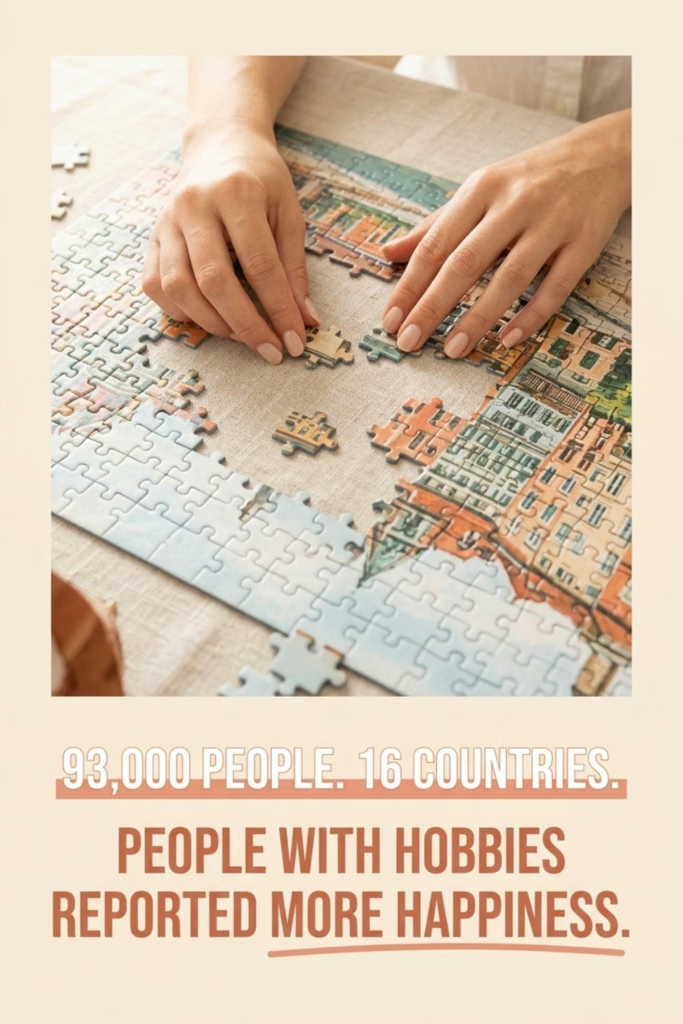
The Harvard Health piece also flags that the study was observational, so it can’t prove hobbies caused the better outcomes. Fair. But the signal is consistent enough that “maybe try having a hobby” seems like a reasonable bet.
What’s genuinely interesting is what a National Geographic summary of the same research highlighted: the specific pastime mattered less than the engagement itself, per National Geographic. Not the type, not the skill level, not whether it has a subreddit with 400,000 members. Just that you were actually doing it. Which is a pretty strong argument for picking something you’ll actually keep doing, even if, especially if, it’s kind of boring.
Why “Boring” Is Doing a Lot of Heavy Lifting Here
When I say boring, I don’t mean joyless. I mean: not performative. Not ambitious. Not another thing that needs to be optimized, tracked, and posted.
Most of us already have enough plates spinning. Work has deliverables. Relationships have expectations. The gym has goals. By the time you get to a hobby, the last thing you need is something that comes with its own pressure system. (I say this as someone who once turned “learning piano” into milestone markers. They were never met.)
A boring hobby, whittling, growing tomatoes, doing puzzles, learning to bake bread badly, collecting something nobody else cares about, lowers the decision fatigue load. You already know what you’re going to do. You don’t have to perform for anyone. Progress is not required. That makes it something you’ll actually return to, which is exactly what drives the benefit.
There’s also something specifically useful here for people running on fumes. UC Davis Health found that spending at least 20% of work time on personally interesting projects was associated with protection from higher burnout rates, per UC Davis Health. A boring hobby outside of work functions the same way, it’s time you’re using for yourself, with no deliverable at the end.
The Identity-Project Trap
Here’s where most hobby advice quietly goes wrong. It tells you to “find your passion” or “build a skill” or “turn it into a side hustle.” Which is fine if that’s what you want. But it accidentally frames every hobby as a project with a destination.
The moment a hobby becomes an identity project, the stakes go up. You’re not just baking; you’re “a baker now,” which means people will notice if you stop. You’re not just jogging; you’re training for something, which means missing a week is a failure. You’ve turned your recovery time into another arena.
A genuinely boring hobby sidesteps all of that. You’re not becoming anything. You’re not building toward anything. You’re just doing a thing that gives your brain somewhere to rest. That, it turns out, is the whole point.
If you want to read more about what it looks like to pursue a hobby without the scoreboard mentality, this piece on why finishing last in your hobby can be a huge win is worth five minutes.
The Arts-and-Crafts Footnote (and Why It Matters)
One specific data point worth flagging: arts and crafts participation was positively correlated with happiness, life satisfaction, and a sense that life is worthwhile, based on a UK national survey dataset from 2019-2020, per CNN. That same CNN report is honest enough to note that arts and crafts weren’t associated with reduced anxiety or loneliness in that particular study, so the benefits aren’t a magic wand across every dimension.
Still: happiness, life satisfaction, a sense of worthwhileness. From drawing and making things. Hobbies that most people would file under “kind of boring.” Not skydiving. Not launching a brand. Sketching, pottery, making bread that comes out lopsided, things you do alone, at a table, without an audience.
Speaking of which, if you’ve ever considered just picking up a sketchbook and seeing what happens, this one’s worth reading. And if you want to start baking bread and fully expect your first loaf to be a structural disaster, you’re not wrong, and that’s fine.
How to Choose a Boring Hobby for Self-Improvement
Not every boring hobby is the right boring hobby. Here’s a practical way to think about it.
It should ask almost nothing of you to get started. The higher the barrier to entry, the easier it is to never start. You want something where the first session costs almost nothing in gear, money, or prerequisite skill. A sketchbook and a pencil. A bag of seeds. A deck of cards for a game you’ve always half-known how to play.
It should be something you can drop and pick back up. Life gets busy. Hobbies that require you to maintain a streak or keep a plant alive on a strict schedule just become another obligation. The best boring hobbies wait for you without judgment. (Plants are negotiable on this one. I’ve killed several. We’re still on speaking terms.)
It should feel slightly pointless. This one sounds counterintuitive, but it’s important. Low-pressure, mindful hobbies for men especially fit this slot, things done alone, at a table, without a scoreboard or a social post. If you can easily explain what the hobby is “for,” it’s probably not boring enough. “I’m learning to whittle so I can sell stuff on Etsy”, that’s a side project. “I whittle little spoons that I give to no one in particular”, that’s a hobby.
It doesn’t have to be your whole personality. You’re allowed to just do a thing without it becoming the thing. The best boring hobbies are like background music, they make the whole room feel better without anyone necessarily pointing at them.
“Enough” Is the Point
There’s something in the hobby conversation that a lot of self-improvement content misses: you don’t have to get better at it. That’s not a bug in the boring-hobby model. It’s the feature.
So much of the “be your best self” genre is quietly telling you that where you are isn’t enough. That if you’re not improving, you’re stagnating. That rest is a strategy, not a real thing you’re allowed to just want. A boring hobby is an act of quiet defiance against all of that. It says: this thing is worthwhile even if I’m bad at it. Even if nobody knows I do it. Even if it never shows up on a resume or a reel.
This is what ‘define your enough’ looks like in practice for self-improvement: you pick the finish line, not someone else’s highlight reel. The research doesn’t actually care whether you got better at the hobby. The 93,000-person study didn’t measure skill acquisition. It measured how people felt. And people with hobbies felt better.
That’s a pretty clean message: doing a thing you like, consistently, for its own sake, is genuinely good for you.
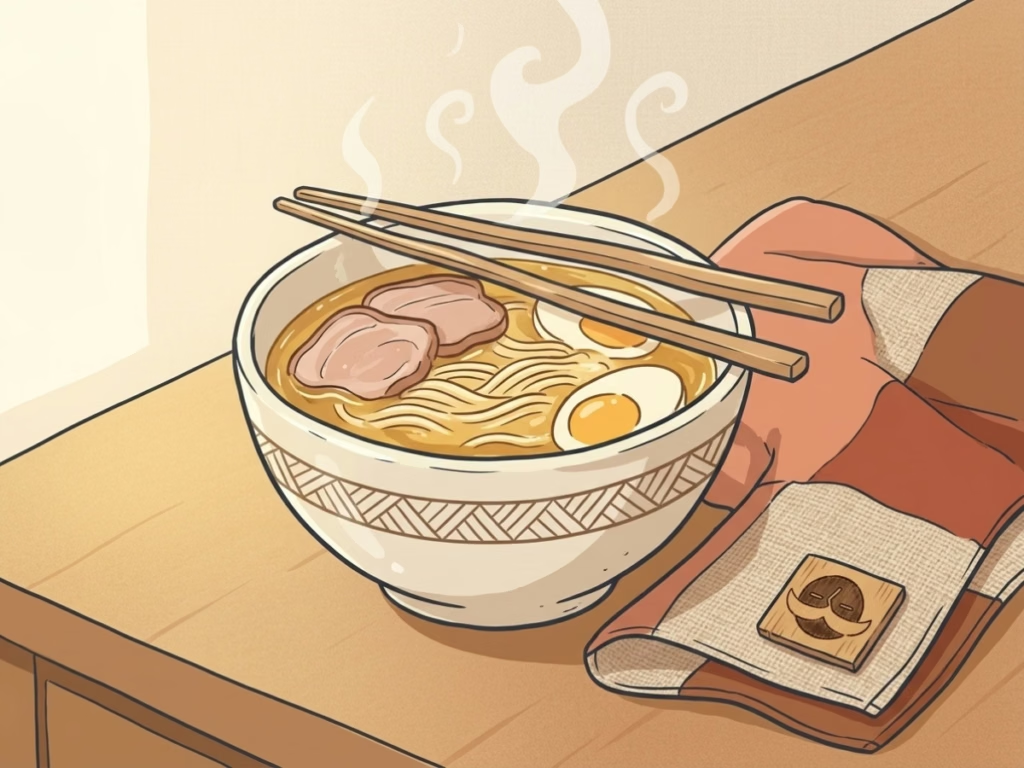
You don’t need to chase a Michelin star. You just need to make some ramen, regularly, because you like making ramen.
Frequently Asked Questions
Do boring hobbies actually improve mental health, or is that just wishful thinking?
The evidence is pretty solid. A 2025 review of 12 articles from 11 studies found hobbies were associated with lower depression, anxiety, and stress, plus better life satisfaction and resilience, per Activities, Adaptation & Aging. The research is observational, so it can’t prove hobbies caused the improvement, but the signal is consistent across thousands of people in multiple countries. That’s enough to make the bet worth placing.
Does it matter what hobby I choose, or can it really be anything?
According to a National Geographic summary of a large international study, the specific pastime mattered less than the engagement itself, per National Geographic. So yes, it can really be anything, as long as it’s something you’ll actually keep doing. The boring, low-pressure option you return to every week beats the exciting, ambitious one you abandon in month two.
Can a hobby help with burnout specifically?
There’s a useful signal here from workplace research. UC Davis Health found that spending at least 20% of work time on personally interesting projects was associated with protection from higher burnout rates, per UC Davis Health. A hobby outside of work functions the same way, time spent on something you find genuinely interesting, with no deliverable attached, seems to give the nervous system a place to recover.
Do I have to be good at my hobby for it to help?
No. The large-scale studies on hobbies and well-being measured how people felt, not how skilled they were. A hobby you’re mediocre at but keep returning to delivers the same basic benefit as one you’ve mastered, maybe more, because low-stakes mediocrity is a lot easier to maintain than high-stakes excellence.
What’s a genuinely “boring” hobby worth trying?
Anything where you already know roughly what you’ll be doing before you sit down: bread baking, sketching, jigsaw puzzles, growing something from seed, woodworking, knitting, building model kits, learning a card game. The hallmark is that it asks nothing of you except your time, has no audience, and would not make compelling content. That’s exactly what you want.
One Thing to Do Today
Don’t spend tonight researching the perfect hobby. Spend ten minutes doing the boring one you’ve already half-thought about. Write something with a pen. Plant something in a pot. Pull out the puzzle you bought two years ago and put twelve pieces together. Set no goal. Don’t time yourself. Don’t tell anyone.
See how you feel in an hour. That quiet little return on investment, that’s what the research has been trying to tell you the whole time.
Get The Enough List — free.
Ten minutes, five areas. A short guide for figuring out what enough looks like in money, health, work, people, and time — before you go sprinting at someone else's finish line. Yours when you subscribe.
Thoughts?