
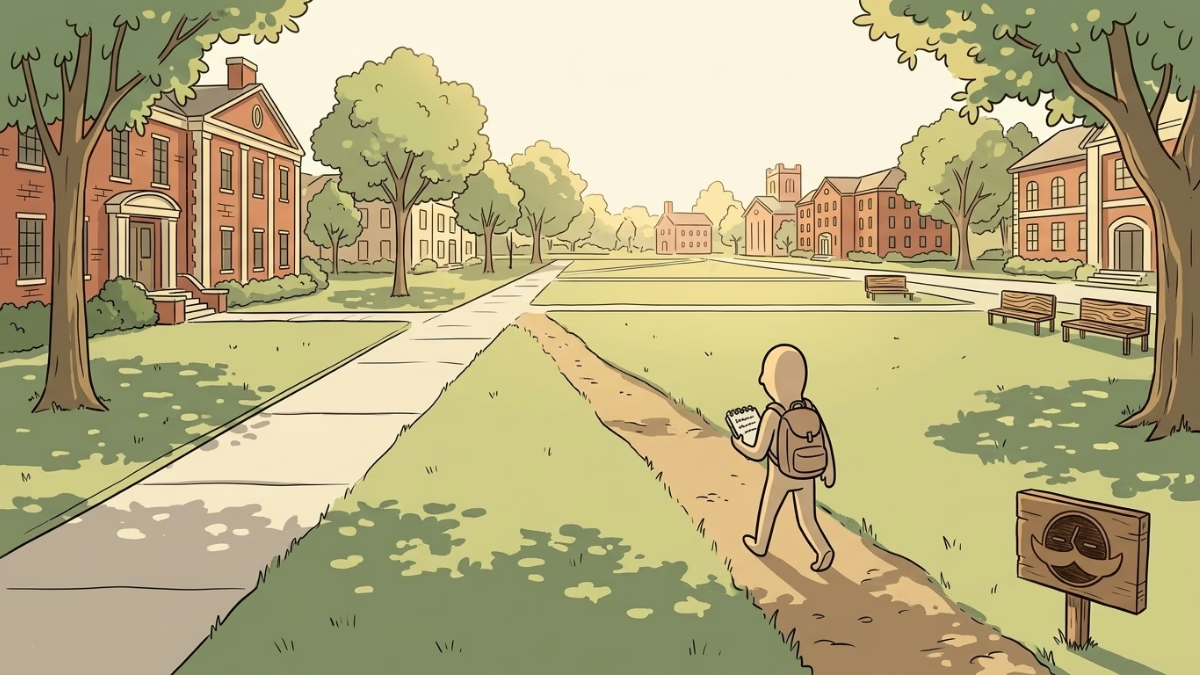
Somewhere on a college campus right now, there’s a perfectly good concrete footpath with zero footprints on it, and a muddy shortcut right next to it with hundreds.
That muddy shortcut has a name: a desire path. A desire path is an informal trail formed when repeated foot traffic bypasses a designed route, usually creating the shortest or most natural line between two points, per Wikipedia. Urban planners study them as evidence of how people actually move through a space, not how the planner intended, per Bumbee Labs. The Guardian’s Robert Macfarlane called them paths made by “wishes and feet,” per The Guardian. That’s a pretty good description of your habits, too.
Key Takeaways
- Desire paths form when formal routes fail to meet people’s real needs, making them a visible record of actual behavior rather than intended behavior.
- Urban planners at the University of Wisconsin identify three reasons people create desire paths: time efficiency, experience, and resistance to an imposed layout.
- In social science, ‘social desire paths’ describe emergent patterns where many independent choices create a visible alternative route over time.
- The practical lesson isn’t ‘always take the shortcut’, some friction is protective; the skill is telling useful friction from pointless friction.
- Noticing where your own desire paths run can reveal the gap between your stated values and your actual priorities.
What Desire Paths Are Telling You (About You)
The University of Wisconsin notes that people create desire paths for three reasons: time efficiency, experience, and resistance to an imposed layout, per UW News. Notice that none of those reasons are “laziness.” People aren’t ignoring the path because they’re checked out. They’re routing around it because it doesn’t fit how they actually live.
Now swap the campus for your own life. Where are your desire paths?
Maybe you set a goal to journal every morning, but you keep reaching for your phone instead. Maybe your workout gear lives in a bag in the hall closet (very on-brand of you, very on-brand of me), so you skip the gym more often than you planned. Those repeated detours are data. They’re a map of the gap between who you want to be and what your environment is actually set up to support.

In social science, “social desire paths” describe exactly this: emergent patterns where many independent choices create a visible alternative over time, per Santa Clara University. At scale, it’s crowds quietly redesigning a city. At the personal level, it’s your habits quietly redesigning your intentions.
The Right Response Isn’t Always to Pave the Shortcut
Here’s where the metaphor earns its keep. The obvious lesson is: notice the desire path and optimize around it. Put the journal on your nightstand, not in a drawer. Put the gym bag by the door, not in the closet. Remove pointless friction.
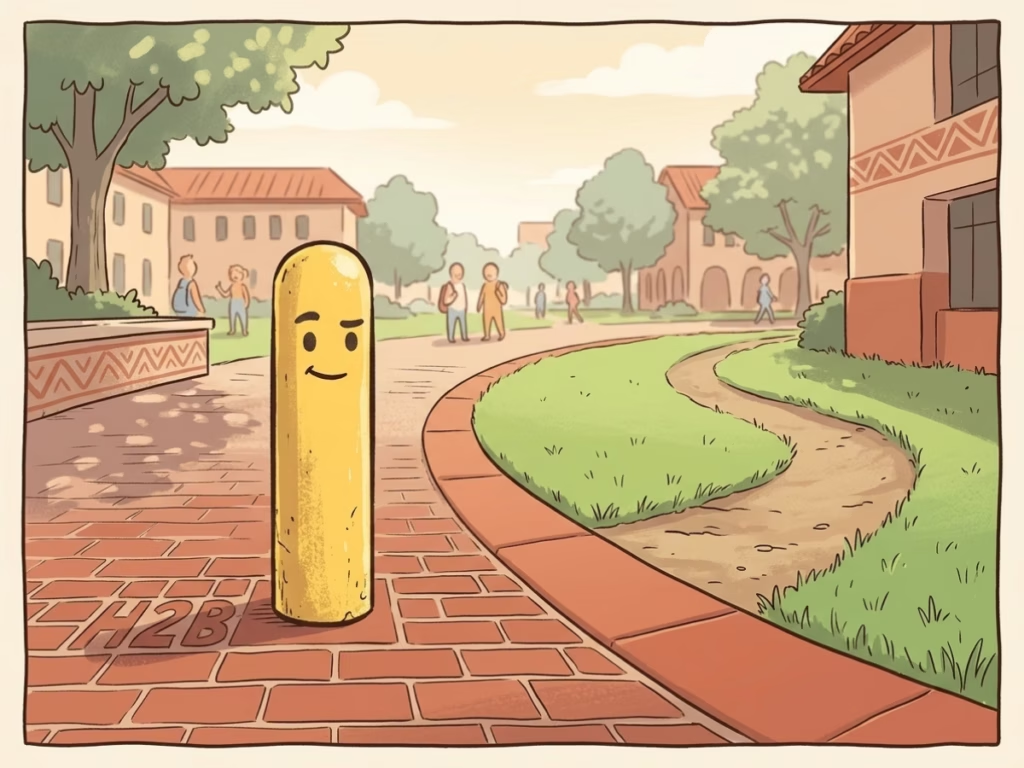
But not every shortcut is worth paving. Some friction is there for a reason. If your desire path is “skip the hard conversation,” that’s not a system to optimize, that’s something to walk through anyway. The skill is learning to tell useful friction from pointless friction. Useful friction builds something. Pointless friction is just a badly placed bollard.
This connects to the paradox of choice, sometimes the “path of least resistance” is just the one with the fewest decisions in the way, and clearing those obstacles is the whole job.
Frequently Asked Questions
What are desire paths in psychology?
In psychology, a desire path is a metaphor for any repeated behavior that diverges from an intended or stated plan. It maps directly onto the gap between stated values and actual choices, the path you keep taking versus the path you think you should take. Social scientists use “social desire paths” to describe how these patterns emerge collectively over time (Santa Clara University).
Why do people create desire paths?
The University of Wisconsin identifies three core reasons: time efficiency, experience, and resistance to an imposed layout (UW News). In plain language: the official route is slower, worse to walk, or just doesn’t match how people actually need to get somewhere.
Are desire paths always the better route?
Not always. The principle behind desire paths is that form should follow actual human behavior, but that only holds when the behavior itself is sound. Some friction in life is load-bearing. The goal is to remove the obstacles that serve no purpose, not every obstacle that feels uncomfortable.
How do I find my own desire paths?
Watch where you consistently diverge from your stated plan. Not once or twice, consistently. That repeated detour is your desire path. Then ask: is this a system problem (easy to fix) or an avoidance problem (worth addressing head-on)? Both answers are useful. Neither one is failure.
Today’s move: pick one habit that keeps not happening and trace the desire path around it. Is there a piece of friction you could remove in the next ten minutes? Move the thing. Change the default. See if the path you want to take becomes the one you actually walk. You might be surprised, turns out the “designed route” was just badly placed all along. And if fixing the friction doesn’t help, at least now you know it’s not the bollard’s fault.
Get The Enough List — free.
Ten minutes, five areas. A short guide for figuring out what enough looks like in money, health, work, people, and time — before you go sprinting at someone else's finish line. Yours when you subscribe.

Thoughts?