
You’ve been sitting on the same decision for three months. Not because you lack information. Because you’re scared of what happens if it goes wrong.
The fear-setting exercise is Tim Ferriss’s answer to exactly that, and if you’ve been wondering what the fear-setting exercise actually is, here’s the short version. It’s a structured journaling method where you write out the worst-case outcomes of the thing you keep avoiding, figure out how to prevent each one, and map out how you’d recover if they happened anyway. Ferriss does it at least once a quarter, often once a month. Not because he has unusually bad luck, but because it works.
This isn’t positive thinking. It’s the opposite of positive thinking. And that’s exactly why it helps.
Key Takeaways
- Tim Ferriss’s fear-setting template uses three columns: Define (worst cases), Prevent (how to reduce their likelihood), and Repair (how to recover if they happen).
- The exercise includes a ‘cost of inaction’ prompt asking what your life looks like in 6 months, 12 months, and 3 years if you avoid the decision entirely.
- Ferriss does the exercise at least once a quarter, often once a month, for decisions he finds himself avoiding.
- Fear-setting works best on concrete, specific decisions, quitting a job, moving cities, starting a project, not on vague background anxiety.
- The method connects to Stoic negative visualization: naming the worst case out loud tends to shrink its emotional grip.
The Three-Column Template (Define, Prevent, Repair)
Ferriss’s core template uses three columns: Define, Prevent, and Repair.
“If you want a ready-made fear-setting template, the three columns below are all you need, open a notes app and label them Define, Prevent, and Repair (no special software, no $49 course required):
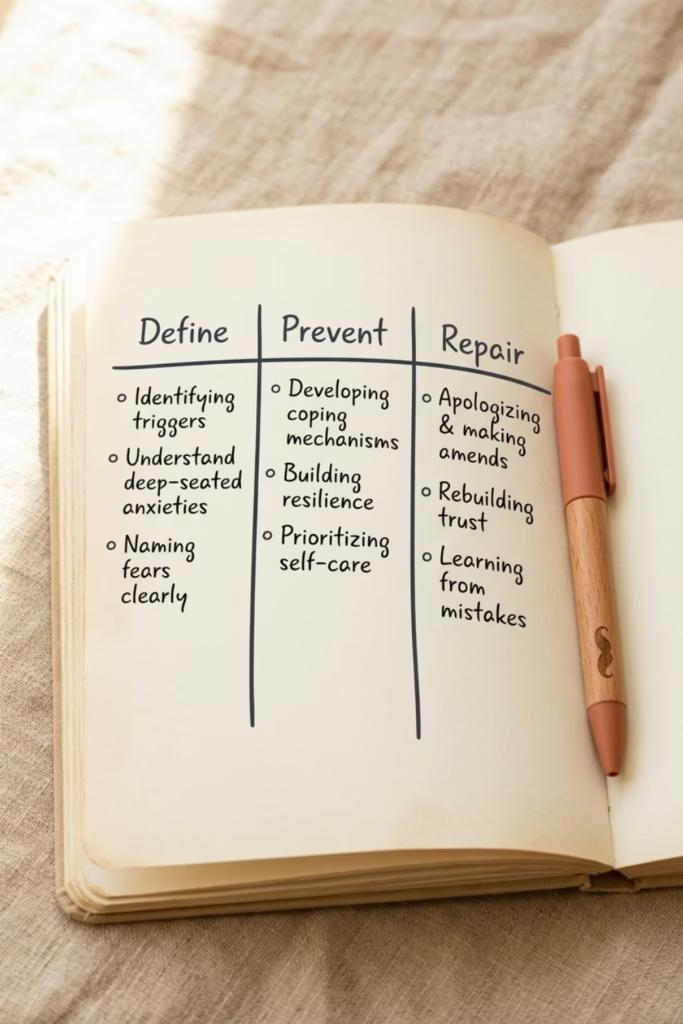
Define: List every bad thing that could realistically happen if you take the action you’re afraid of. Be specific. Not “it’ll go badly” but “I lose the client, I’m short on rent for two months, my ego takes a hit.” Get it all out. The brain is very good at generating vague dread and very bad at actually cataloguing what it’s dreading.
Prevent: For each item on that list, write one or two things you could do to reduce the odds of it happening. Most worst-case outcomes have at least one lever you can pull. You probably won’t pull all of them. That’s fine. The point is to realize the outcome isn’t a meteor falling from space, it’s something you have partial control over.
Repair: If the worst-case still happened, how would you recover? This column is the one that tends to surprise people. Most of the scenarios we’ve been quietly catastrophizing for weeks turn out to be survivable, fixable, or at least recoverable-from-eventually. Seeing that written down does something the mental loop doesn’t.
The Part Everyone Skips: Cost of Inaction
Here’s where fear-setting earns its keep over a regular pros-and-cons list.
After the three columns, the exercise asks you one more question: what does your life look like in 6 months, 12 months, and 3 years if you do nothing?
Sitting with the status quo feels safe. But the status quo has a cost too. It’s just slower and quieter, so we don’t weigh it the same way.

This prompt forces you to. Sometimes you fill it in and realize the answer is basically “fine, I was overthinking it.” Occasionally you fill it in and realize you’ve been trading a manageable risk for a guaranteed slow decline. Both are useful things to know.
This is what connects fear-setting to Stoic negative visualization, the ancient practice of deliberately imagining bad outcomes to reduce their emotional power. The Stoics figured this out without a TED Talk. Ferriss just gave it a template.
(If you want to pair this with a real goal framework, the SMART goals breakdown over here connects well.)
When to Use It (and When Not To)
Fear-setting is built for specific decisions you keep avoiding, quitting a job, having a hard conversation, launching the thing, moving somewhere new. It’s not a fix for generalized anxiety or the low-level hum of modern existence. That’s a different conversation. This tool is a scalpel, not a bandage.
It also works better if you do it on paper, or at least typed out, not just in your head.

The loop in your head has been running the same track on repeat. Getting it into columns on a page breaks the loop. (Think of it as dragging a file out of the background processes and actually closing it.)
If you’ve been putting off a decision long enough that it’s now background noise, that’s probably the one to start with.
Frequently Asked Questions About the Fear-Setting Exercise
What is the fear-setting exercise?
Fear-setting is a structured journaling exercise developed by Tim Ferriss for decisions you keep avoiding. The method uses three columns. Define, Prevent, and Repair, to map out worst-case outcomes, ways to reduce them, and how you’d recover if they happened. It ends with a “cost of inaction” prompt asking what your life looks like in 6, 12, and 36 months if you do nothing.
How often should you do fear-setting?
Ferriss does it at least once a quarter, often once a month. There’s no magic frequency. A practical rule: run it whenever you notice you’ve been avoiding making a decision for longer than it deserves.
Is fear-setting the same as positive thinking?
No, it’s closer to the opposite. The exercise asks you to deliberately imagine bad outcomes, not dismiss them. That’s borrowed from Stoic negative visualization, which uses intentional worst-case imagining to reduce those outcomes’ emotional hold on you. Positive thinking skips the fear. Fear-setting walks straight through it.
What decisions is fear-setting best for?
Fear-setting works best on emotionally, financially, or socially costly decisions you’re actively avoiding, career moves, location changes, starting a project, ending something that isn’t working. It’s not designed for vague life anxiety. Bring it a real, specific decision.
What if the exercise just makes me more anxious?
That usually means you’re staying in the Define column too long. The Prevent and Repair columns are where the exercise actually does its work. If you list every terrible outcome and stop there, you’ve just made a horror reel. Fill in all three columns, then do the cost-of-inaction page. That’s the full loop.
Pick one decision you’ve been sitting on. Not the biggest one, necessarily, just the one you keep thinking about and then setting down. Open a note, make the three columns, and give it 20 minutes. The worst case is probably not what your brain has been quietly playing on loop at 2am. And if you want a place to put the goal that comes out the other side, this sanity-check framework is a decent next stop.
Get The Enough List — free.
Ten minutes, five areas. A short guide for figuring out what enough looks like in money, health, work, people, and time — before you go sprinting at someone else's finish line. Yours when you subscribe.