The 5am cold plunge, the 45-minute workout, the journaling, the gratitude, the protein shake, and the meditative silence before the kids wake up. Cool routine. Also a second job nobody signed you up for.
A realistic morning routine for men is not a performance scorecard. It’s a damage-control system for days that already start behind. The best version is the one you’ll still run when you slept badly, the kids were up at 3am, or you’ve got a 7:30 call that showed up on your calendar last night.
Key Takeaways
- Sleep inertia, the groggy, impaired state after waking, can last from minutes to hours, making peak-output tasks right after an alarm a bad idea for most people.
- A realistic morning routine should be built around your actual constraints first: sleep quality, commute, kids, or stress, not an influencer’s ideal conditions.
- Small movement (a 10-minute walk or a quick mobility block) fits a sustainable routine far better than a full pre-dawn workout most men won’t sustain.
- Consistency beats optimization: a three-step routine you repeat daily compounds faster than a twelve-step routine you abandon by Thursday.
Sleep Inertia Is Real, and It Hates Your Optimization Plan
Here’s the thing nobody in the “win the morning” crowd talks about: your brain is genuinely broken for a while after you wake up. Sleep inertia, the groggy, impaired state right after waking, can last from minutes to hours, especially after waking abruptly from deep sleep. So stacking complex tasks the moment your alarm goes off is less “optimizing” and more “trying to pilot a plane while still on the runway.”
Which means the metric of “winning” the morning is already broken. If you got four hours of patchy sleep (stress will do that, we’re all aware), the only honest W is surviving it with some dignity intact.
What a Realistic Morning Routine for Men Actually Looks Like
Forget the 12-step sequence. Here’s what holds up:
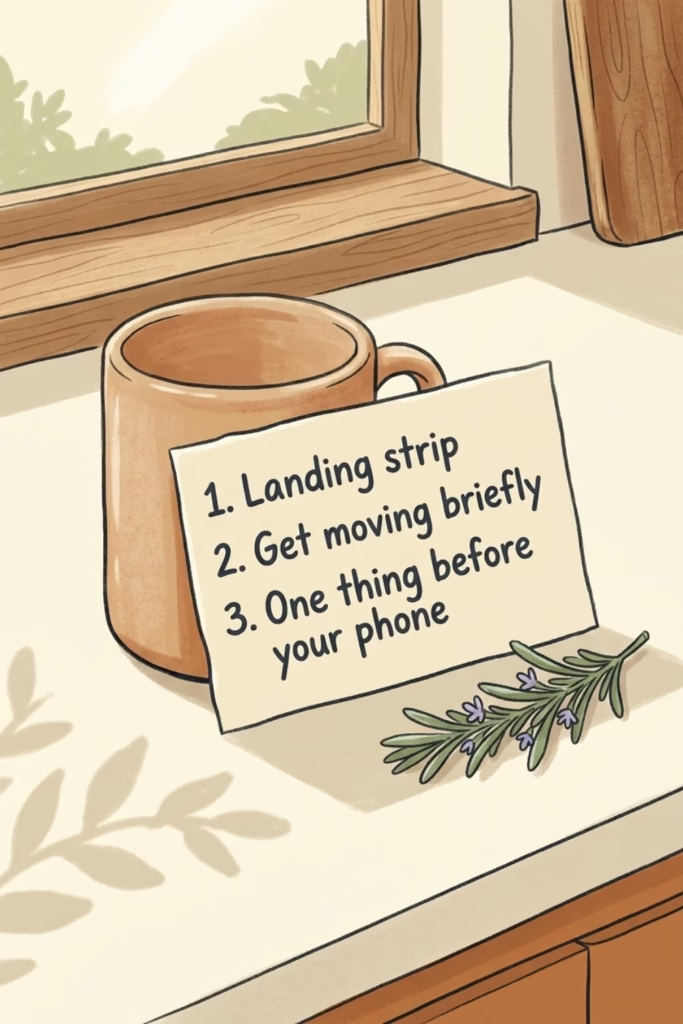
1. Give yourself a landing strip. Five to ten minutes where you’re not expected to perform. Sit with coffee. Stare at the wall. Let the brain boot up. (It’s doing that whether you schedule it or not.)
2. Get outside or get moving, briefly. A ten-minute walk counts. Morning light helps anchor your body clock, and even a short walk outside is enough to get some. We’ve written about a 10-minute workout when it’s too hot to go hard, same logic applies here.
3. One intentional thing before you open your phone. Write in a notebook, make your bed, or take two slow breaths. One thing. Not five. The 5-minute journal is good for this if you need a place to start.
That’s it. Three steps. Won’t impress anyone on social media. Works every single morning, including the bad ones.
The “Enough” Version of a Morning
Anthony Bourdain believed that the kitchen is the last meritocracy and that aiming for perfection was a foolish ideal. A morning routine that requires perfect conditions to function is just a fantasy you’re visiting occasionally.
Build yours around your actual life, commute, shift, kids, energy level, not around what someone optimized for a lifestyle you don’t have.

A three-step routine repeated daily for a year beats a twelve-step routine that collapses every Thursday. (And it will collapse on Thursday. That’s just what Thursday’s do.)
Frequently Asked Questions
Why does “winning the morning” advice so often fail in practice?
Most of it is built for ideal conditions, rested, low-stress, no dependents, flexible schedule. When those conditions break (and they will), the whole routine falls apart. Sleep inertia can impair function for minutes to hours after waking, which makes demanding peak-output tasks first thing a structurally bad idea on any rough night.
How short can a morning routine actually be and still be useful?
Very short. Three steps done consistently beats twelve steps done sporadically. If you get outside briefly, do one intentional thing before the phone comes out, and protect ten minutes of low-demand time after waking, you’re ahead of most elaborate routines that collapse by mid-week.
Does skipping the workout in the morning mean I won’t get enough exercise?
Not at all. The goal is movement that’s sustainable, not movement at a specific hour. A 10-minute walk, a mobility block, or movement later in the day still counts. What matters is that it’s repeatable.
What if my mornings are genuinely chaotic (kids, early shifts, commute)?
This is exactly where a simple morning routine for busy men earns its keep. Your routine needs to work inside that chaos, not pretend it doesn’t exist. Cut it to one or two anchors, maybe just coffee without the phone for five minutes and a short walk. Constraints aren’t excuses; they’re the actual design parameters.
Today’s move: write down your actual morning constraints (wake time, first obligation, energy level on a typical night). Then pick ONE thing you can do before your phone is in your hand. Just one. Do it tomorrow. Build from there.
That’s the whole plan.
Get The Enough List — free.
Ten minutes, five areas. A short guide for figuring out what enough looks like in money, health, work, people, and time — before you go sprinting at someone else's finish line. Yours when you subscribe.