

Most journaling advice quietly assumes you have the energy of a graduate student with a new Moleskine. You don’t. Three lines is enough, and there’s actual research behind that claim.
A randomized controlled trial found that positive affect journaling reduced mental distress, anxiety, and perceived stress in medical patients with mild to moderate anxiety symptoms. A separate review of journaling interventions found an average 5% improvement in mental health scores overall, with stronger effects in anxiety (9%) and PTSD (6%) subgroups. Nobody in either study was writing a memoir. The bar is lower than you think.
If you’ve been trying to figure out how to start journaling without it feeling like a chore, the answer is probably simpler than you’ve been told.
Key Takeaways
- A randomized controlled trial found positive affect journaling reduced mental distress, anxiety, and perceived stress in participants with mild to moderate anxiety symptoms.
- A review of journaling interventions found an average 5% improvement in mental health scores, with stronger effects in anxiety (9%) and PTSD (6%) subgroups.
- Starting with two to three honest sentences per entry, rather than long reflections, is a research-backed approach to making the habit stick.
- Pairing journaling with an existing routine (habit stacking) reduces the friction that kills most new habits before week two.
- Forgiving missed days, rather than treating journaling like a daily performance test, is a key factor in long-term consistency.
How to Start Journaling Without It Feeling Like a Chore
The enemy of journaling isn’t laziness. It’s start cost. The moment you open a blank page thinking “I should write something meaningful,” your brain files it under homework and wanders off to look at your phone instead. (Been there. Still go there, honestly.)
Starting with two to three honest sentences, rather than longer reflections, is a practical recommendation for keeping the habit alive long enough to matter. One good, ugly sentence beats three paragraphs you never write.
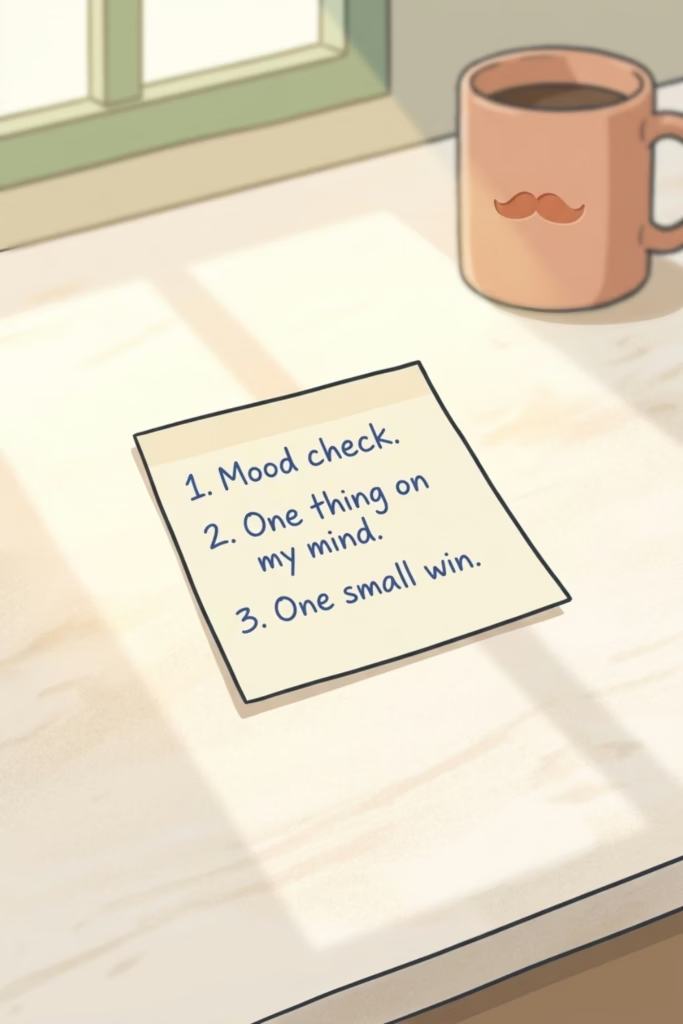
The format that actually works:
- One line: mood check. How are you actually doing right now? Not “fine.” One real word or phrase.
- One line: decision filter. What’s one thing that’s sitting on your brain today, a choice, a task, something unresolved?
- One line: shutdown signal. Something small that went okay. Doesn’t have to be inspirational. “Had my coffee before it got cold” counts.
That’s it. You’re done. The whole thing takes ninety seconds, which is less time than reading the replies under a mildly controversial tweet. (Not that any of us do that.)
How to Make It Stick Without Willpower
The journal has to be visible.

If it lives in a drawer, it will die in that drawer. Leave it on the counter, next to your coffee mug, beside your laptop charger, wherever you already stop and exist for a moment each morning or night.
Better yet, pair it with something you already do. This is habit stacking: attach a new behavior to an existing one so you’re not relying on willpower to remember it. We use this same idea to beat procrastination, and it works here just as well.
Miss a day? Fine. Miss three? Also fine. Forgiving missed days, rather than treating journaling like a performance you can fail, is a real factor in staying consistent over months instead of just the first week of October.
The worst journaling habit beats the perfect one you abandoned in November.
Frequently Asked Questions
Does journaling actually reduce stress, or is it just trendy?
There’s real research behind it. A randomized controlled trial linked positive affect journaling to reduced mental distress, anxiety, and perceived stress in participants with mild to moderate anxiety symptoms. A broader review found a 5% average improvement in mental health scores from journaling interventions, with higher effects for anxiety (9%) and PTSD (6%). The effect isn’t magic, but it’s consistent enough to take seriously.
How long should a journaling session be?
Short enough that you don’t dread it. Five to ten minutes is a reasonable ceiling, and three lines often takes less than two. The goal is a habit that survives a bad Tuesday, not one that only works when you’re feeling reflective and caffeinated.
What do I write if I have nothing to say?
Write that. “Nothing is happening and I feel flat” is useful data about your day. You can also fall back on the three-line format above: mood, one thing on your mind, one small win. No prompt required beyond that.
Should I journal in the morning or at night?
Whichever you’ll actually do. Morning journaling works well as a thought-sorter before the day starts; evening journaling works well as a shutdown ritual. Pick the slot that already has a quiet moment in it, and stack the habit onto something already there.
Today: find one notebook (ugly is fine), put it somewhere you can’t ignore it, and write three lines before you go to sleep tonight. Not three good lines. Just three. That’s the whole job.
Get The Enough List — free.
Ten minutes, five areas. A short guide for figuring out what enough looks like in money, health, work, people, and time — before you go sprinting at someone else's finish line. Yours when you subscribe.

Thoughts?