
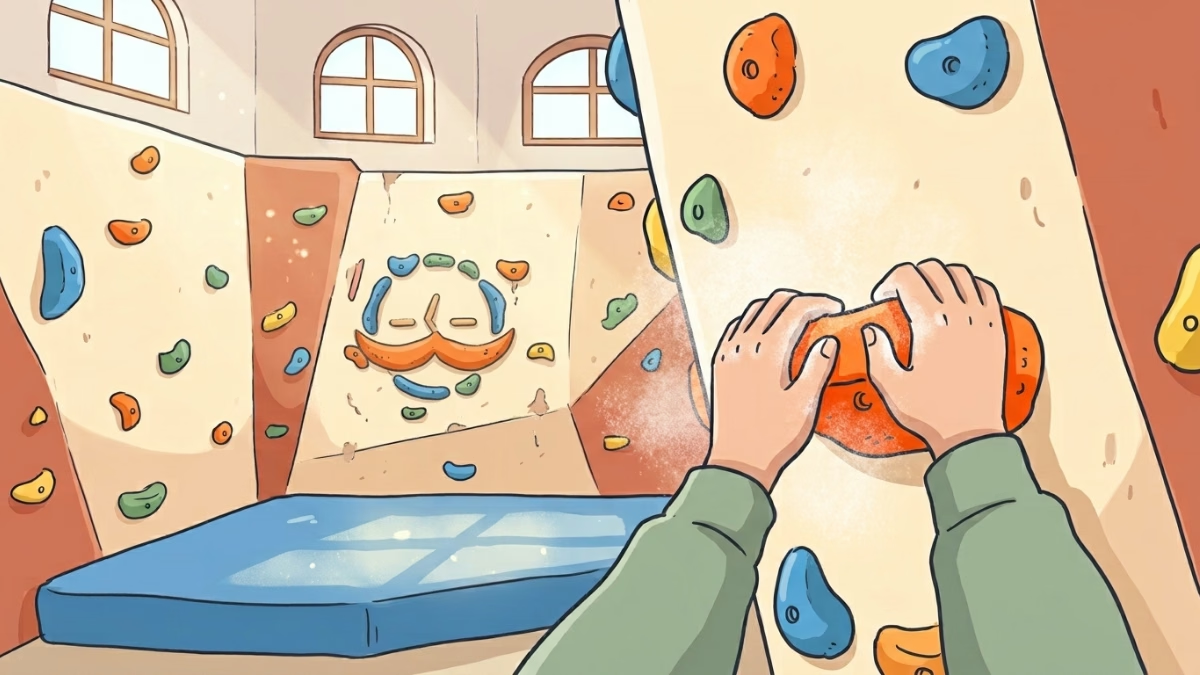
You peel off the wall for the eighth time and land on the mat. Eight times. Same problem. Same move you can’t stick. And somehow, the thought that surfaces isn’t I’m terrible at this, it’s okay, what if I shift my left foot three inches?
That’s not you being unusually zen. That’s bouldering doing exactly what the research says it does. A 2026 randomized clinical trial found that a bouldering psychotherapy group reduced depressive symptoms by a mean of 4.2 points, with a remission rate of 17.6% compared to just 2.6% in the control group receiving treatment as usual, per PubMed. That’s what makes bouldering for mental health a different conversation than the usual exercise-is-good-for-you headline. It’s the falling. The reset. The trying again. The sport is specifically built around failure, which turns out to be one of the more effective mental health interventions researchers have stumbled onto.
Key Takeaways
- A 2026 RCT found bouldering psychotherapy produced a -4.2-point reduction in depressive symptoms and remission in 17.6% of participants vs. 2.6% of controls.
- A 2025 systematic review of 6 RCTs and 1 controlled clinical trial (471 total participants) found indoor bouldering combined with mindfulness reduced depression symptoms, with effects sustained up to 12 months, and no adverse events reported.
- A 2024 psychosocial bouldering intervention in Lebanon produced an adjusted mean effect size of d = 0.45 for improved mental well-being.
- Bouldering’s psychological value appears to come from bounded problem-solving, not adrenaline, making sessions feel restorative rather than depleting.
- Rock climbing was associated with significantly lower Separation Anxiety Disorder and Generalized Anxiety Disorder scores in adolescents (p < 0.001 and p = 0.031, respectively).
What Bouldering Actually Is (And Why the Gym Doesn’t Own It)
Bouldering is rock climbing stripped down to its essentials. No ropes, no harness, no partner required, just you, a short wall (typically under 15 feet), padded mats below, and a sequence of moves called a “problem.” You attempt the problem until you solve it or until your forearms give up and go full cooked-spaghetti on you. Then you rest, choose another one, and start again.

That structure is the point. Each problem is self-contained. You’re not logging miles, chasing a score, or comparing yourself against a leaderboard. You’re just solving a puzzle with your body, and the stakes of failing are exactly zero, you land on a mat, dust your hands off, and try a slightly different approach. (If you’re picturing Mission: Impossible cliff hangs, it’s considerably more attainable. Most gyms have problems rated easy enough for genuinely complete beginners, and you’ll look far less ridiculous than you’re imagining.)
What makes it distinct from the gym treadmill grind is that bouldering demands your full attention. You can’t zone out and think about emails. The wall forces you present in a way that only a few activities manage without being dangerous about it.
What the Research Says About Bouldering for Mental Health
The evidence here is worth sitting with, because it’s more specific than most “exercise is good for mental health” headlines.
A 2025 systematic review synthesized findings from 6 randomized controlled trials and 1 controlled clinical trial, 471 participants total, and found that indoor bouldering combined with mindfulness exercises reduced depression symptoms in adults with moderate depression, with effects sustained for up to 12 months, per PMC. Twelve months. That’s not a post-session buzz wearing off by Tuesday. And notably: no adverse events were reported across any of the studies. So this particular experiment has a decent safety record.
A separate 2024 trial out of Lebanon found that a psychosocial bouldering intervention produced an adjusted mean effect size of d = 0.45 for improved mental well-being compared to a control group, per PMC. In plain English: a medium-to-solid effect, the kind researchers consider clinically meaningful rather than just statistically lucky.
And it’s not only depression. A 2024 study on adolescents found rock climbing was associated with significantly lower scores on Separation Anxiety Disorder and Generalized Anxiety Disorder measures, with p-values of less than 0.001 and 0.031 respectively, per PMC. Anxiety and depression often travel together, and bouldering seems to help with both. Honestly, at this point the sport is doing more for mental health than half the wellness industry’s newsletter content combined.
Why Falling Is the Practice, Not the Failure
Here’s the thing most coverage of climbing-and-mental-health gets wrong: they focus on the confidence boost you get when you succeed at a hard move. Sure, that feels good. But the real psychological work happens in the repetition of failure.
Every time you fall off a bouldering problem, you’re running a small experiment. You hypothesize, test, get feedback, adjust. The wall is completely honest with you, it doesn’t care about your ego or your day or whether you’ve had a rough week. If the move works, you advance. If it doesn’t, you learn something and go again. There’s no social cost to getting it wrong eight times before you get it right. Nobody’s grading you. The gym regulars are too focused on their own problems (literally) to track yours.

This is actually a training ground for something harder than climbing: the part of life where most of us take one shot at something, get it wrong, feel embarrassed, and quietly abandon it. Bouldering rewires that reflex at a low cost per repetition.
A 2025 qualitative study of therapeutic climbing in psychiatric inpatients found participants described climbing as emotionally uplifting, mentally focusing, socially connecting, and physically strengthening, per Medical Xpress. That list isn’t accidental. The focus and the emotional lift aren’t separate things, the laser attention the wall demands is what produces the reset. You can’t catastrophize about a work meeting while you’re trying to figure out a heel hook.
The Bounded Problem-Solving Effect
There’s a pattern worth naming: bouldering’s mental health benefit appears to come less from “adrenaline rush” and more from what you might call bounded problem-solving. Each problem has clear rules, a clear goal, and clear feedback. You know when you’ve failed (you’re on the mat) and you know when you’ve succeeded (you’re on the top hold). That kind of clarity is the opposite of most adult stressors, which are vague, ongoing, and don’t give you a mat to land on.
This also explains why bouldering tends to feel restorative rather than depleting, even after a hard session. You came in with a cluttered head, the wall forced you to be present and specific for an hour, and you left with a clearer one.
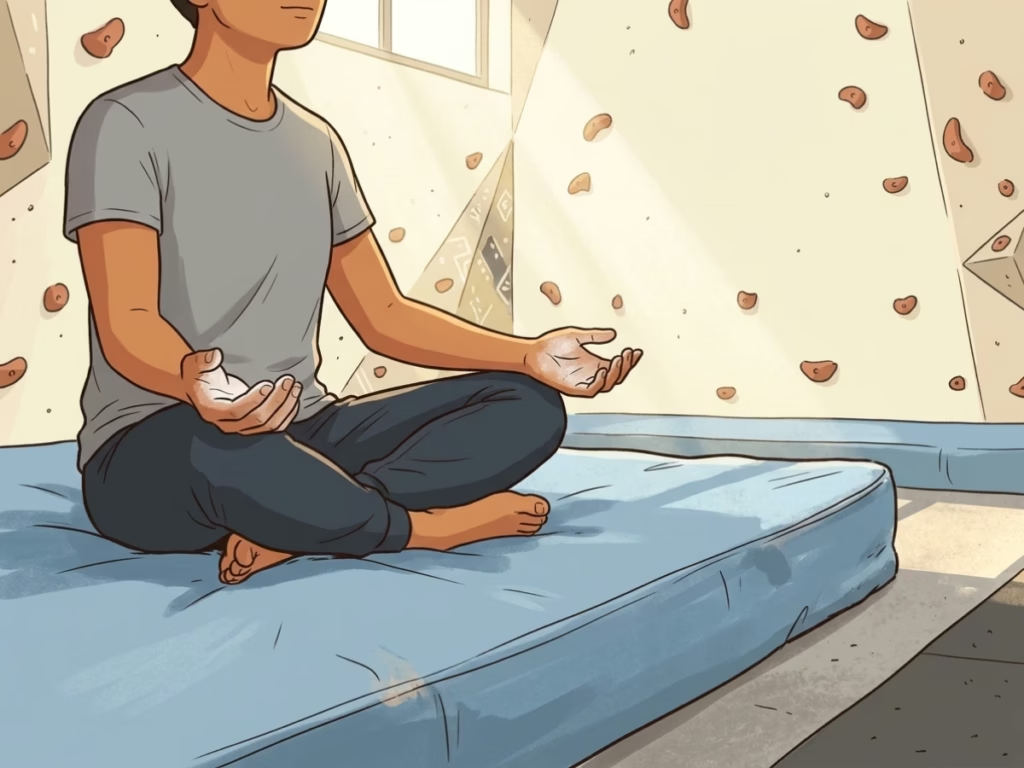
The problems you solved were small, but the process of solving them borrowed nothing from your other resources.
It’s a bit like finishing last in your hobby: the scoreboard doesn’t matter because you weren’t playing the scoreboard game. You were playing your own game, with your own progress metric, and that turns out to be the one that actually improves your week.
The Anxiety Paradox: More Discomfort, Less Anxiety
The research on climbing and anxiety is where things get genuinely interesting. One finding that complicates the tidy story: a 2025 cross-sectional study found climbers experienced significantly more anxiety during lead climbing (where you clip a rope as you go and a fall means dropping past your last clip) than during top-rope climbing, with state anxiety scores of 40.1 versus 33.1, per PubMed. So climbing can also create anxiety, specifically when the stakes of falling go up.
Bouldering sits in an interesting middle position here. You don’t have the rope system anxiety of lead climbing, you’re falling onto a mat, not dropping six feet past a clip. But there’s still genuine exposure to discomfort: heights feel real even at 12 feet, unfamiliar moves feel uncertain, and choosing a problem that’s slightly past your current ability is a small, voluntary act of facing something hard. That consistent low-dose discomfort, without the high-stakes panic of lead, seems to be the sweet spot.
Controlled discomfort is the whole game. Which, if you’ve spent any time reading about how people actually change and grow, will sound familiar. The path from “anxious about failure” to “more okay with failure” runs directly through voluntarily experiencing failure in a setting where the consequences are a padded landing and chalk dust on your palms.
How to Actually Start Without Making It a Whole Personality
You don’t need a training plan, a crash pad, or a belayer certification.

You need a nearby gym, shoes (most gyms rent them, and beginner rentals are fine until you decide you like this), and the willingness to look confused for the first hour.
Most indoor bouldering gyms offer a first-visit orientation that covers the basics: how the hold colors correspond to difficulty, how to read a problem, and critically, how to fall safely. That last one matters. Learning to fall correctly is not dramatic, it’s landing on both feet, bending your knees, and not reaching out to catch yourself with your wrists. Takes about five minutes to learn. Worth knowing.
The ideal approach for a first session: pick problems clearly rated below your presumed ability. Solve them without rushing. Rest between attempts. Notice what you’re thinking about (spoiler: not much besides the next hold). Mess up. Try again.
Leave before you’re exhausted. Beginners consistently overdo their first session because the forearm pump (the burning tightness climbers get when their grip muscles are spent) comes on fast and sneaks up on you. Two hours of climbing feels like nothing until your hands can’t open a car door. You’re looking for “that was satisfying” rather than “I can no longer operate cutlery.” Know your enough for the day.
That capacity to define your own enough and stop there, incidentally, is also part of what makes this different from the hustle-sport framing some gyms try to push on you. You don’t have to train. You don’t have to project. You can go, fall off some colorful holds, get a mental reset, and leave. The sport will meet you wherever you are.
For the record, bouldering shares some of that same restorative attention quality with a walk with no destination required, two activities that look like they’re about the body and turn out to be mostly about quieting your head.
Frequently Asked Questions
Does bouldering actually help with depression, or is it just “exercise is good for you”?
It’s more specific than the generic exercise benefit, and more targeted than general bouldering therapy for depression claims you’ll find in wellness content. A 2026 randomized clinical trial found that a bouldering psychotherapy group achieved a remission rate of 17.6% versus 2.6% in controls, with a mean depressive symptom reduction of -4.2 points, per PubMed. A 2025 systematic review of 471 participants across 7 trials found sustained effects lasting up to 12 months, per PMC. That’s not just “get some fresh air” territory.
Do I need to be fit or athletic to start bouldering?
No. The entry-level problems at any gym are designed for people who have never climbed anything in their life. The grip strength and technique come with time, beginners don’t need either to get value from a first session. Most people start on the easier grades and find those genuinely engaging for months before wanting more.
How is bouldering different from regular rock climbing for mental health purposes?
Bouldering removes the rope, harness, and partner from the equation, which lowers the barrier to entry and removes a layer of social coordination. The fall consequence is a padded mat rather than dropping on a rope, which keeps anxiety within a manageable range. Research on state anxiety found that lead climbing produced significantly higher anxiety scores (40.1) than top-rope climbing (33.1), so bouldering sits in the lower-stakes zone while still offering the problem-solving focus that drives the mental health benefit, per PubMed.
How often do I need to go to see mental health benefits?
The clinical interventions in the research varied in structure, but the sustained 12-month effects in the systematic review suggest that even a consistent once-or-twice-a-week habit is enough to matter. This is not a sport that requires daily sessions to return value.
Is bouldering safe for someone with existing anxiety?
Based on available research, yes, a 2025 systematic review covering 471 participants reported no adverse events across any of the included studies, per PMC. The controlled, low-stakes fall environment makes it a relatively gentle exposure to discomfort. That said, if you’re managing a serious anxiety disorder, checking in with a mental health professional before starting is the sensible move, not because climbing is risky but because tailored guidance is always better than internet advice from a self-improvement blog.
Here’s the concrete thing you can do today: find an indoor bouldering gym within reasonable distance and book a first visit. Most gyms have a website with pricing and first-timer info. You don’t need to read anything else first, buy any gear, or feel ready. Show up, rent shoes, let the staff explain the basics, and fall off some walls. That’s it. The research will take care of the rest.
Get The Enough List — free.
Ten minutes, five areas. A short guide for figuring out what enough looks like in money, health, work, people, and time — before you go sprinting at someone else's finish line. Yours when you subscribe.

[…] to read about other counterintuitive things that look like failure but aren’t, the piece on why falling is the point in bouldering goes somewhere […]