

Nobody handed you a life schedule at birth. The feeling that you’re behind, that slow dread when a college acquaintance posts about their second house or their kid’s first piano recital, isn’t a signal that you’re failing. It’s a signal that you’ve been running someone else’s race without realizing it.
That’s the whole problem with feeling behind in life. There is no official scoreboard. There’s just a pile of cultural defaults that got into your head before you had a chance to vet them.
Key Takeaways
- Feeling behind in life is a comparison problem, not a progress problem. You’re using someone else’s milestones as a measuring stick for your life.
- Benchmarks like “house by 30” or “promotion by 35” are cultural defaults, not personal contracts. They carry no authority over your actual situation.
- A personal scoreboard with three inputs (sleep, money, relationships) is more actionable and more honest than a vague ‘life progress’ tally.
- The antidote to timeline anxiety isn’t lower ambition, it’s a clearly defined finish line you actually chose.
- Regaining control one day at a time matters more than catching up to a pace you never set.
The Benchmarks Are Arbitrary (And They Were Never Yours)
“House by 30.” “Married by 32.” “Senior title by 35.” These are checkpoints someone invented, somewhere, probably in a decade when the economy looked completely different and your specific situation didn’t exist yet.
They feel authoritative because everyone seems to believe them. But consensus isn’t the same as correct. (Lots of people once agreed the world was flat. Still wrong.)
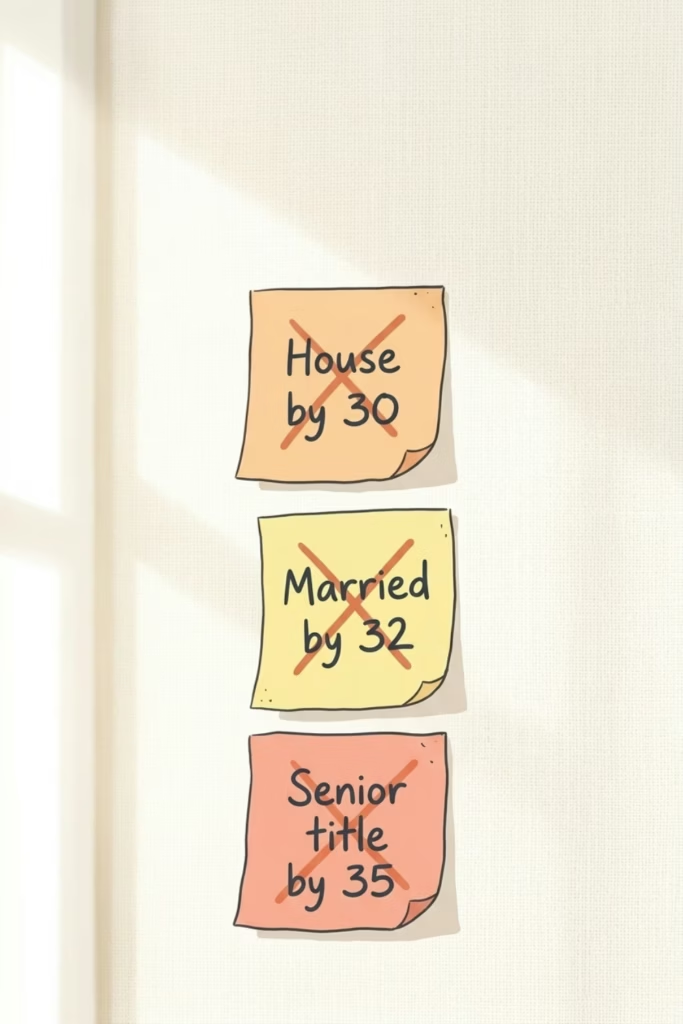
The comparison trap works like this: you see someone hit a milestone, your brain clocks it as evidence of your own delay, and suddenly you’re not measuring your life against your goals, you’re measuring it against their highlight reel. That’s a game you cannot win, because the reel never ends and you’re never the editor.
Anthony Bourdain wrote about something adjacent to this, the idea that you don’t have to follow the established path to end up somewhere worth being. He didn’t hit his stride until his 40s. Probably felt behind plenty of times before that.
The Fix Isn’t Running Faster
Here’s what most “stop feeling behind” advice misses: the goal is not to catch up. Catching up to a race you didn’t enter just exhausts you and deposits you at someone else’s finish line.
The actual move is building your own scoreboard, with fewer categories and clearer limits on what “enough” looks like.
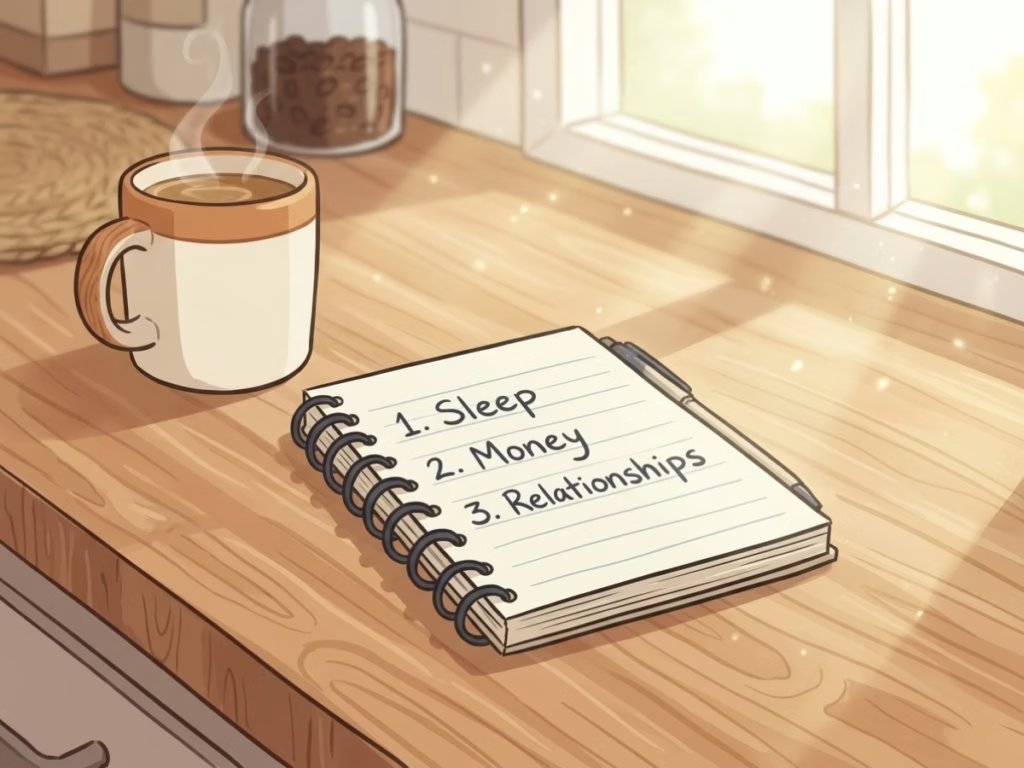
Try this: shrink your scoreboard to three inputs this week.
- Sleep. Are you getting enough to function like a human? (Not a productivity robot. A human.)
- Money. Are your basic needs covered and is the number trending in a direction you can live with? Not “am I rich.” Trending okay.
- Relationships. Is there at least one person in your life you’d call if things went sideways?
That’s it. That’s the whole scorecard for this week. Not career arc, not net worth versus your college roommate’s LinkedIn, not square footage.
This isn’t lowering your ambition. It’s giving ambition a sensible starting point. Pacing works the same way in endurance sports, the guys who blow out of the gate convinced they’re behind and need to make up for it with an explosion of energy at the start usually don’t finish.
What “Enough” Actually Requires
Defining your own enough means doing something most productivity culture actively discourages: planting the finish line before you start sprinting at it.
Pick one area of your life where the “behind” feeling hits hardest. Write down what “enough” looks like in that area, not “ideal,” not “impressive to others.” Just enough. The thing where you’d genuinely feel settled if you hit it.
Now check whether that definition came from you or from a benchmark you absorbed from somewhere else. If it came from somewhere else, that’s not a goal. That’s somebody else’s expectation you’ve been chasing.
There’s a whole framework for this in the life trade deadline piece, what you’re actually trying to keep, cut, and add, versus what you think you’re supposed to want. Worth a read if the scoreboard problem runs deeper than one area.

Frequently Asked Questions About Feeling Behind in Life
Why do I keep feeling behind in life even when things are going okay?
Feeling behind in life usually has nothing to do with your actual progress, it’s a social comparison reflex that fires whenever you see someone else hit a visible milestone. It’s your brain treating their timeline as the default, even though no such default exists. The fix is interrupting the comparison with a concrete look at your own defined goals, not someone else’s.
Is it normal to feel like I’m behind in my 30s?
Completely normal, and arguably more common in your 30s than any other decade, it’s when cultural benchmarks (career, family, property) pile up fastest and the gap between “where I am” and “where I’m supposed to be” feels most visible. The benchmarks are louder; that doesn’t make them more valid.
That stack of benchmarks is what drives life timeline anxiety, the specific low-grade dread that you’re running behind a schedule nobody actually handed you.
How do I stop comparing myself to others when social media is everywhere?
You probably can’t stop the initial comparison, that’s just how brains work. What you can do is give it less fuel. One practical move: replace the vague “am I doing well enough overall?” question with a specific three-item check (sleep, money, relationships) so your brain has an actual answer to land on instead of defaulting to whoever just showed up in your feed.
Does feeling behind mean I need to set bigger goals?
Not necessarily. Sometimes the opposite is true. The “behind” feeling often means your goals are vague or borrowed, not that they’re too small. A specific, personally-chosen goal, even a modest one, beats a big impressive one you never actually wanted.
What if I genuinely have lost ground (job loss, health setback, tough year)?
Then the goal is regaining control one day at a time, not catching up to where you think you should be. That distinction matters. “Catch up fast” creates panic and bad decisions. “Regain traction today” creates momentum. Those aren’t the same direction even if they sound similar.
Today: write down the three-input scorecard (sleep, money, relationships) and score yourself honestly on each one, not against anyone else, just against “okay.” That’s your actual baseline. Everything else is someone else’s race.
Get The Enough List — free.
Ten minutes, five areas. A short guide for figuring out what enough looks like in money, health, work, people, and time — before you go sprinting at someone else's finish line. Yours when you subscribe.

[…] a version of this worth reading in more depth over at You’re Not Behind in Life. There Is No Scoreboard, which is essentially an extended meditation on the same thing. Worth your […]