

You opened Instagram for thirty seconds and somehow you’re now behind on your career, your fitness, your apartment, and your entire life trajectory. Welcome to the comparison spiral, population: everyone who’s ever had a phone.
Here’s the thing: you are not broken for doing this. Comparing yourself to others is not a character flaw or a sign of low confidence. It’s a predictable cognitive habit that every human brain runs, described as far back as 1954 when psychologist Leon Festinger laid out what he called social comparison theory, the idea that we evaluate ourselves by measuring against the people around us. Your brain is doing what brains do. The problem is that the inputs it’s working with are, to put it gently, garbage.
The fix isn’t to “think positive” or tape affirmations to your bathroom mirror (though you do you). It’s to change the benchmark. Measure yourself against your past self, not against someone else’s curated highlight reel. Define what “enough” actually looks like for you before you start chasing it. And, probably, put the phone down more than you currently do.
That’s the short version. Here’s the longer one.
Key Takeaways
- Social comparison is a built-in cognitive tendency, first described by Leon Festinger in 1954, not a sign that something is wrong with you.
- People consistently compare their own worst qualities against other people’s best qualities, a distortion, not an objective ranking, per Psychology Today.
- Replacing “other people” with ‘past me’ as your benchmark is a named, practical shift that BetterUp’s comparison research explicitly recommends, per BetterUp.
- Defining your own ‘enough’ before you start chasing a goal means you actually get to feel the win when you arrive, instead of moving the goalposts.
- Reducing your exposure to comparison triggers (social media, certain conversations) is often more effective than trying to think your way out of a comparison spiral.
Why Comparing Yourself to Others Feels Worse Right Now (It’s Not Just You)
There’s a specific reason the comparison spiral hits harder in the 2020s than it did when your dad was your age. It’s not that you’re softer. It’s that the exposure is relentless.
Your grandfather compared himself to the guys on his street and the guys at work. Maybe a magazine or two. You compare yourself to thousands of people, curated by an algorithm designed to surface the most aspirational, attention-grabbing content available. Every scroll is a highlight reel from people who are, statistically, not representative of normal life, they’re the outliers, the polished, the ones who figured out the lighting.
Psychology Today’s research on comparison points out something that should make you feel immediately better: people consistently compare their own lesser qualities against other people’s best qualities, per Psychology Today. You’re not doing an objective ranking. You’re watching someone else’s championship reel and grading it against your blooper reel. Of course you come out behind. The comparison was never fair to begin with.

And it compounds when you’re already feeling low. Psychology Today’s guidance on comparison specifically flags that spirals are often mood-dependent, you’re most vulnerable to the comparison trap exactly when you’re already not feeling great. (Which is also, not coincidentally, when you’re most likely to reach for the phone.)
The Benchmark Problem
Here’s the core issue with “how to stop comparing yourself to others as a man”: most advice treats it like a discipline problem. Just don’t compare! Be grateful! Focus on your own lane!
That’s like telling someone to “just sleep more.” Technically correct, practically useless.
The comparison instinct doesn’t go away. What you can do is give it a better target.
BetterUp’s research on this is pretty direct: use your past self as the benchmark instead of other people, per BetterUp. Not the guy from your high school who’s now apparently a VP. Not the fitness influencer who has the body you want and also, notably, a full-time job of having that body. You, six months ago. You, last year.
This matters because it’s a benchmark you can actually win against, and winning against it is proof of real progress. Did you handle that stressful situation better than you would have eighteen months ago? Did you cook more meals at home this month than last month? Did you finally stop letting that one friendship drain you dry? (If you’re working on that last one, the piece on reclaiming your time and energy is worth fifteen minutes of your day.)
The past-self benchmark also has a useful side effect: it forces you to actually notice your own progress, which most of us are spectacularly bad at. We’re wired to habituate to improvement. The thing you struggled with two years ago that you now do without thinking? You stopped counting it. Start counting it again.

Define “Enough” Before You Sprint at Anything
There’s a version of “stop comparing yourself” advice that quietly smuggles in a new comparison. Stop comparing yourself to others… so you can become your best self… so you can reach your full potential… so you can maximize your output. And suddenly you’re back on the hamster wheel, just as a slightly more philosophical hamster.
The actual move is to plant your own finish line before you start running.
What does “enough” look like for you? Not in the abstract, specifically. Enough money means what, exactly? Enough fitness means what? Enough career progress means what? If you can’t answer that, you’ll keep moving the goalposts every time you get close, because there’s always someone further ahead to compare yourself to.
We wrote about this more directly in Stop Chasing Better. What Does Good Look Like to You?, but the short version is: the goal isn’t to stop being ambitious. It’s to know what you’re actually aiming at so that when you get there, you get to feel it. Most people who are stuck in comparison loops have never actually defined the target. They’re sprinting toward a vague “more” and feeling bad that they haven’t arrived yet.
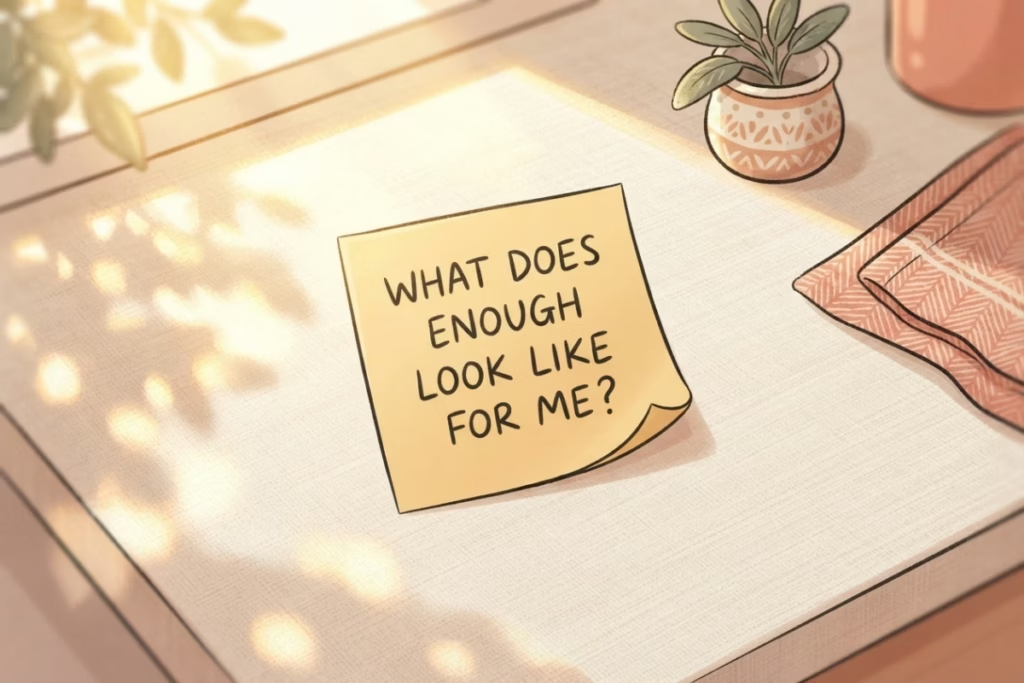
Write it down. Seriously. What does your enough look like? Not someone else’s enough. Yours.
The Environmental Fix Nobody Talks About Enough
Here’s the unsexy truth about how to stop comparing yourself to others: a lot of it is just reducing your exposure to comparison triggers.
You can do all the mindset work you want, but if you’re spending two hours a day scrolling through content specifically engineered to make you feel behind, you’re fighting a forest fire with a garden hose.
The research on this is pretty consistent. Psychology Today’s guidance on comparison specifically recommends limiting social media use when you’re already feeling low, because that’s when the spiral is hardest to interrupt, per Psychology Today. You don’t have to delete everything. You probably just need some friction, move the apps off your home screen, set a time limit, pick one or two accounts that actually make you feel good and unfollow the rest without ceremony.
This is also where the permission to do nothing angle is relevant. Offline time isn’t wasted time. It’s time where the comparison machine is off. You don’t need to justify it.

What to Do When the Spiral Hits Anyway
Even with a better benchmark and less exposure, comparison will still land on you sometimes. Someone from your past shows up in your feed looking like they’ve figured everything out. A conversation at work makes you feel like you’re running three years behind. It happens.
When it does, Acheron Psych’s practical guidance is worth keeping in your back pocket: pause, breathe, practice self-compassion, and redirect your attention to your own values or something you’re genuinely grateful for — and that gratitude habit, practiced consistently, is one of the quieter ways self-esteem actually gets built. That sounds almost embarrassingly simple, but the pause is the whole thing. Most comparison spirals run on autopilot. The moment you notice you’re in one, you’ve already broken the loop.
From there, Zen Habits has a useful reframe: count what you have, focus on what you’re actually good at, and make peace with the fact that imperfection is the factory setting for every human alive, per Zen Habits. Not as a toxic-positivity exercise, but as a genuine recalibration. You’re not behind. You’re on your own timeline, which is the only timeline you were ever going to be on.
I’ll be honest: I still catch myself doing the comparison math sometimes. Someone my age with a bigger platform, a cleaner apartment, a more impressive-looking life. And then I remember I have approximately zero information about what their actual day looks like, what they’ve given up, or whether they’re happy. I’m comparing my inside to their outside. It’s not a fair fight, and it never was.
The Quiet Version of Self-Improvement
The comparison trap is, at its core, a distraction from the only competition that actually matters: are you better than you were? Not better than him. Not ahead of her. Better than the version of you from last year who was stuck on that thing you’re not stuck on anymore.
Quiet self-improvement is mostly unglamorous. It doesn’t photograph well. Nobody’s going to post a reel of themselves getting slightly better at handling conflict, or finally sticking to a sleep schedule, or learning to be okay with where they are while still working toward where they want to be. But that’s the real work, and it compounds in ways the highlight reel never does.
Perfectionism and comparison are a package deal. Perfectionism sets an impossible bar, comparison finds someone who appears to clear it, and the loop runs itself.
If you want a pace-setter for this kind of long-game thinking, the Tour de France pace for normal guys piece is a good one to read next. The principle is the same: sustainable beats spectacular, every time.
Frequently Asked Questions
Is comparing yourself to others always a bad thing?
Not always. Comparison can be useful when it shows you a direction you genuinely want to move in, seeing someone who’s good at something you want to get better at can be motivating. The problem is when comparison becomes a scorecard for your worth, rather than a compass for your direction. If seeing someone else’s success makes you want to grow, that’s useful. If it just makes you feel bad about where you are, that’s the loop worth breaking.
Why do I always feel worse after scrolling social media?
Because social media is a highlight reel, and your brain is comparing it to your unfiltered reality. Psychology Today’s research on comparison notes that people naturally compare their own weaknesses to other people’s strengths, per Psychology Today, and social media makes that distortion worse by surfacing only the best moments. The fix isn’t willpower; it’s reducing the exposure, especially when you’re already not feeling great.
What does “compare yourself to your past self” actually mean in practice?
Pick one area of your life and think about where you were twelve months ago. What were you struggling with then that you handle better now? What did you not know that you know now? What habit did you not have? That delta is your actual progress. Write it down if you need to make it feel real, most of us are so focused on the gap ahead that we never register the ground we’ve already covered.
How do I define my own “enough” without just lowering my standards?
Defining “enough” isn’t about settling. It’s about knowing what you’re actually aiming at so you can recognize when you’ve arrived. The question isn’t “what’s the most I could possibly achieve?” It’s “what would genuinely make me feel like my life is going well?” Those are different questions with different answers, and only the second one has a finish line you can actually cross. Ambition and contentment can coexist, they just need a target.
Does this get easier over time?
Yes, with practice. The comparison instinct doesn’t disappear, but you get faster at noticing it and faster at redirecting it. The biggest shift most people report is when they stop treating comparison as evidence of something being wrong with them, and start treating it as a signal to check in on their own benchmark. What do I actually want? Where am I actually going? Those questions crowd out the comparison math pretty quickly.
One Thing to Do Today
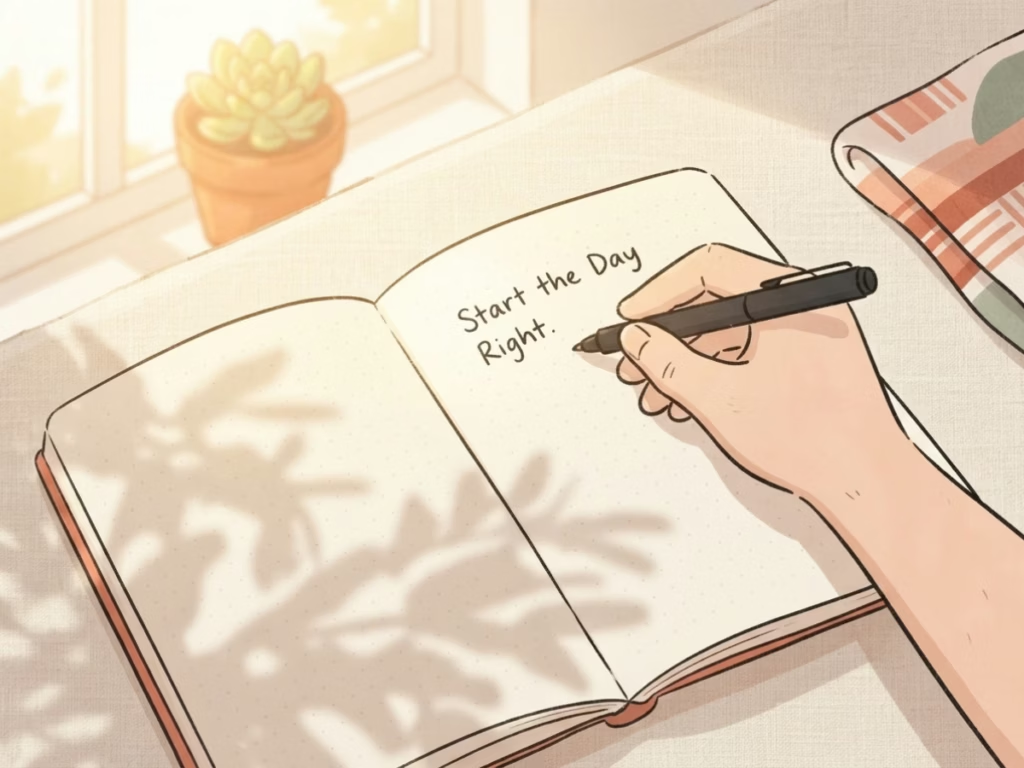
Before you open any social media today, spend five minutes writing down one thing you’re genuinely better at than you were a year ago. Not better than anyone else. Better than past-you. It doesn’t have to be impressive. It just has to be true.
That’s your benchmark. That’s the only scoreboard worth keeping.
Get The Enough List — free.
Ten minutes, five areas. A short guide for figuring out what enough looks like in money, health, work, people, and time — before you go sprinting at someone else's finish line. Yours when you subscribe.
[…] antidote isn’t lowering your standards. It’s stopping the comparison loop that makes your chapter one feel like a failure because someone else is on chapter […]
[…] working on how you measure yourself against other people’s opinions more broadly, this piece on stopping the comparison spiral is worth five […]